The Four Grand Slam Tournaments Explained: Surfaces, Traditions, and Challenges
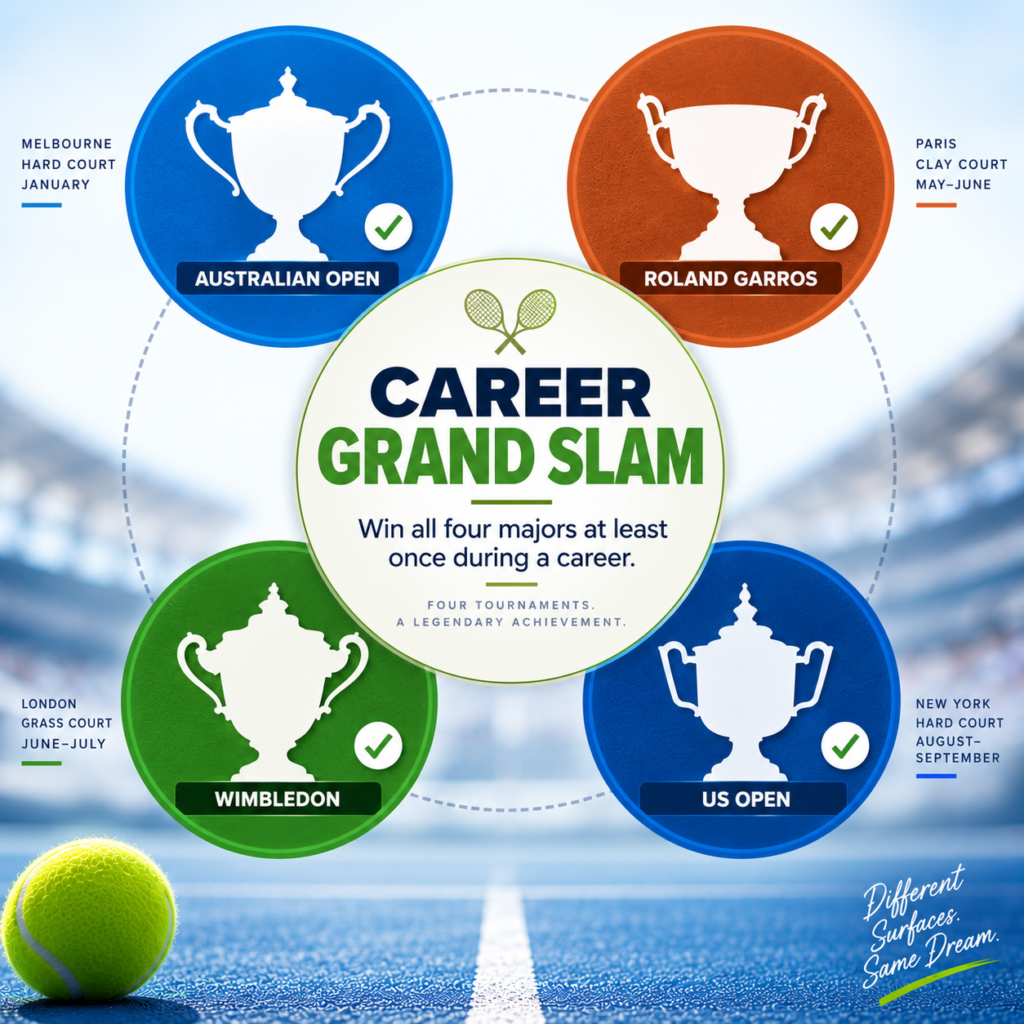
They challenge players in different ways.
Melbourne brings the demands of summer heat and hard-court competition. Paris rewards patience and movement on clay. Wimbledon tests balance and precision on grass. New York adds the intensity of hard-court tennis in a particularly energetic environment.
A player who feels comfortable at one tournament may need to make substantial technical and tactical adjustments at another.
That variety is one of the reasons the Grand Slams remain central to the identity of professional tennis.
To understand what makes these tournaments special, it is worth examining their history, surfaces, traditions, and the challenges they present.
What Are the Four Grand Slam Tournaments?
The four Grand Slam tournaments are the Australian Open, French Open, Wimbledon, and US Open.
They are the most prestigious recurring individual tournaments in tennis and form the foundation of the sport’s major championship calendar.
Each is staged annually and includes men’s and women’s singles, doubles, and other competitions.
In singles, Grand Slam champions earn 2,000 ranking points under the standard ATP and WTA ranking systems.
These tournaments also differ from most regular tour events because men’s singles matches are contested over the best of five sets, while women’s singles matches use the best-of-three format.
Although their competitive status is shared, each Grand Slam has developed a distinctive identity.
Australian Open: The Grand Slam of the Asia-Pacific
History and Development
The Australian Open traces its origins to the Australasian Championships, first held in 1905.
Over time, the tournament expanded in international significance and eventually became established in Melbourne.
Its modern identity is closely associated with Melbourne Park, which has hosted the tournament since 1988.
The Australian Open is traditionally the first Grand Slam of the calendar year.
That position creates an unusual challenge: players must prepare for a major championship shortly after the off-season.
Some arrive with excellent physical preparation, while others are still adjusting to competitive match intensity.
Surface: Hard Court
The Australian Open is played on an acrylic hard-court surface.
Hard courts generally offer a more consistent bounce than natural grass or clay, although their exact speed and playing characteristics depend on the court construction, coating, weather, and ball specifications.
Players need a balanced game.
Effective serving is important, but strong returning, baseline consistency, and movement are equally valuable.
Because hard courts provide relatively predictable ball behavior, players can develop aggressive patterns using both power and placement.
The Challenge of Australian Summer Heat
One of the Australian Open’s defining challenges is the Melbourne summer.
High temperatures can affect endurance, hydration, recovery, and concentration.
Long matches in hot conditions demand careful physical preparation.
The tournament uses an extreme heat policy that can affect play when conditions become sufficiently severe.
Major show courts also have retractable roofs, providing additional flexibility when weather conditions disrupt the schedule.
However, indoor conditions can change the way the ball travels and how players approach rallies.
Australian Open Traditions
The Australian Open has developed a reputation for combining major championship competition with a festival-like atmosphere.
Large crowds, extensive entertainment areas, and night sessions contribute to its identity.
Rod Laver Arena is the tournament’s most recognizable stadium.
The venue honors Rod Laver, one of tennis’s greatest champions and a central figure in the sport’s history.
What Kind of Player Succeeds in Melbourne?
The Australian Open tends to reward players with complete hard-court skills.
Strong serving, efficient movement, reliable returns, and the ability to sustain long rallies are important.
Physical resilience is particularly valuable when matches extend into demanding conditions.
Success often depends on maintaining performance across seven singles matches rather than producing one exceptional result.
French Open: The Ultimate Test on Clay
History of Roland-Garros
The French Open developed from the French Championships, first held in 1891.
The competition eventually became an international championship and moved to Stade Roland-Garros in Paris in 1928.
The venue was named after Roland Garros, a pioneering French aviator.
Today, the tournament is widely known as Roland-Garros.
It is the only Grand Slam played on clay courts.
That distinction gives it a unique technical identity.
Surface: Red Clay
Clay courts are constructed using multiple layers, with crushed brick material forming the recognizable red playing surface at Roland-Garros.
Compared with many hard and grass courts, clay typically slows the ball after the bounce and can produce higher rebounds.
These characteristics often create longer rallies.
Players have more opportunities to defend, recover position, and construct points over several shots.
However, describing clay as universally slow is an oversimplification.
Temperature, moisture, ball type, and court preparation can significantly influence playing conditions.
Why Movement Is Different on Clay
Clay-court movement requires a specialized technique.
Players frequently slide into shots, using controlled movement to maintain balance while changing direction.
Learning when and how to slide is essential.
Players unfamiliar with clay can struggle with footing, especially when attempting to stop or accelerate as they would on a hard court.
Successful clay-court competitors combine strong footwork with the ability to recover quickly after wide defensive shots.
Why Topspin Matters at Roland-Garros
Heavy topspin is particularly useful on clay because it can produce a high bounce and push opponents away from the baseline.
This creates opportunities to open the court or attack shorter returns.
However, topspin alone is not enough.
Players must also understand shot depth, angles, variation, and the right moment to move forward.
Clay rewards patience, but passive play can allow opponents to control rallies.
Rafael Nadal and the Identity of Roland-Garros
No player has become more closely associated with the French Open than Rafael Nadal.
The Spanish champion won 14 men’s singles titles at Roland-Garros, an extraordinary record at one Grand Slam tournament.
His heavy topspin forehand, exceptional movement, defensive ability, and competitive intensity made him particularly effective on clay.
Nadal’s achievements helped define an era of the tournament.
Yet Roland-Garros has also celebrated many other champions whose success came through different combinations of power, movement, and tactical intelligence.
What Makes the French Open Difficult?
The greatest challenge is often sustaining concentration and physical performance through extended rallies.
Clay can make it more difficult to finish points quickly.
Players must be prepared to defend repeatedly while searching for opportunities to attack.
Matches can become demanding tests of endurance, tactical discipline, and emotional control.
Wimbledon: Tradition Meets Grass-Court Tennis
The Oldest Grand Slam Tournament
Wimbledon began in 1877 at the All England Croquet and Lawn Tennis Club.
It is the oldest of the four Grand Slam tournaments.
The competition developed during the early growth of lawn tennis and remains closely associated with the sport’s historical traditions.
Unlike the other three Grand Slams, Wimbledon is played on grass.
Its distinctive playing surface is central to its identity.
Surface: Natural Grass
Grass courts generally produce a lower bounce than clay and can reward efficient serving and early ball striking.
However, modern grass-court tennis is not identical to the game played several decades ago.
Changes in grass composition, court preparation, equipment, and player technique have influenced playing characteristics.
Modern Wimbledon matches can include extended baseline rallies, even though effective serving and quick reactions remain important.
Why Grass-Court Movement Is Challenging
Grass presents a distinctive movement challenge.
The surface can become slippery, particularly when moisture is present or when the grass wears during the tournament.
Players need controlled footwork and good balance.
Because the ball may stay relatively low, they must also adjust their body position and timing.
Shots that are comfortable on clay may become more difficult when the bounce is lower and the available reaction time is reduced.
Wimbledon’s White Clothing Tradition
One of Wimbledon’s most recognizable traditions is its strict clothing policy.
Competitors are required to wear predominantly white clothing, subject to the tournament’s detailed regulations and permitted exceptions.
The tradition dates back to the sport’s earlier social culture and has become part of Wimbledon’s identity.
While some players and commentators have questioned aspects of the rules, the tournament continues to maintain its distinctive dress standards.
Royal Patronage and Championship Traditions
Wimbledon has a long association with the British royal family.
Royal attendance, ceremonial customs, and the tournament’s presentation contribute to its historical atmosphere.
Strawberries and cream have also become closely associated with the event.
These traditions help distinguish Wimbledon from the other Grand Slams.
However, the tournament is not simply a historical celebration.
It remains a modern, highly competitive championship that has adapted to changes in technology, scheduling, and player requirements.
What Kind of Player Succeeds at Wimbledon?
Grass-court success requires efficient serving, precise movement, and the ability to handle lower or less predictable bounces.
Strong return positioning and early ball striking can be particularly valuable.
Players who transition effectively between defense and attack often perform well.
Although serve-and-volley tennis was historically prominent, modern Wimbledon champions can succeed with a variety of styles.
US Open: Power, Pressure, and New York Energy
History of the US Open
The US Open traces its origins to the US National Championships, first held in 1881.
The tournament evolved through several locations and playing surfaces before becoming established at the USTA Billie Jean King National Tennis Center in New York.
It moved to Flushing Meadows in 1978.
The US Open is traditionally the final Grand Slam of the calendar year.
Its position late in the season creates a distinctive physical and psychological challenge.
Surface: Hard Court
Like the Australian Open, the US Open is played on hard courts.
However, the two tournaments do not necessarily play identically.
Differences in court coatings, ball characteristics, temperature, humidity, and other conditions can affect the speed and bounce of the ball.
The US Open has used Laykold hard-court surfaces since 2020.
Players must combine aggressive shot-making with consistency and strong defensive movement.
The Challenge of New York Conditions
Late-summer conditions in New York can be hot and humid.
Humidity can make physical recovery more difficult during extended matches.
Players must also manage the pressure of competing in large stadiums with energetic crowds.
Arthur Ashe Stadium, the tournament’s main venue, is one of the most recognizable tennis arenas in the world.
Night sessions create a particularly distinctive atmosphere.
For some players, the crowd’s energy provides motivation.
Others must work harder to maintain concentration amid the noise and intensity.
Why the US Open Can Be Unpredictable
By the time the US Open begins, players have already completed much of the professional season.
Accumulated fatigue, injuries, and changes in form can influence performance.
The transition from earlier tournaments to the North American hard-court season also requires careful preparation.
As a result, the US Open can produce unexpected results, especially when highly ranked players arrive physically or mentally exhausted.
Comparing the Four Grand Slam Surfaces
The playing surface is one of the clearest differences between the four Grand Slams.
| Tournament | Surface | Typical Challenge |
|---|---|---|
| Australian Open | Hard | Heat, physical endurance, balanced baseline play |
| French Open | Clay | Sliding, long rallies, topspin, patience |
| Wimbledon | Grass | Low bounce, balance, early timing, serving |
| US Open | Hard | Humidity, crowd intensity, late-season fatigue |
These characteristics describe general tendencies rather than fixed rules.
Actual playing conditions can vary significantly from one year to another.
Why Winning All Four Grand Slams Is So Difficult
Winning a Grand Slam title requires seven successful singles matches against increasingly difficult opposition.
Winning all four across a career demands something more.
A player must adapt to three different court surfaces, different climates, and the changing physical demands of a long season.
Clay specialists may struggle with the lower bounce of grass.
Players who rely heavily on serving may find it more difficult to dominate extended rallies on clay.
Even strong hard-court players can face different tactical challenges in Melbourne and New York.
To win all four, a player must develop a game that remains effective under varied conditions.
What Is a Career Grand Slam?
A Career Grand Slam occurs when a player wins each of the four major singles championships at least once during their career.
The titles do not need to be won in the same year.
Several legendary players have achieved this distinction.
Examples include Andre Agassi, Roger Federer, Rafael Nadal, Novak Djokovic, Serena Williams, and Maria Sharapova.
The achievement demonstrates versatility across different tournament environments.
What Is a Calendar-Year Grand Slam?
A calendar-year Grand Slam is achieved when a player wins all four major singles titles in the same calendar year.
This is considerably more difficult than completing a Career Grand Slam.
The player must maintain exceptional form across the entire season while adapting to each surface in succession.
Rod Laver completed the men’s singles calendar-year Grand Slam in 1962 and 1969.
Steffi Graf achieved the women’s singles calendar-year Grand Slam in 1988.
Graf also won Olympic singles gold that year, completing what became known as the Golden Slam.
How Grand Slam Tennis Has Changed Over Time
Although the Grand Slams preserve many traditions, they have changed significantly.
Racket technology has increased the power and spin available to modern players.
Sports science has transformed physical preparation and recovery.
Electronic line calling and video review have influenced officiating.
Retractable roofs have reduced some weather-related disruptions at major venues.
Scheduling policies have also evolved as organizers attempt to balance broadcasting requirements, player welfare, and spectator expectations.
These developments have helped the Grand Slams remain relevant while preserving their historical identities.
Why Grand Slam Titles Matter More Than Ordinary Tournament Victories
Grand Slam titles carry exceptional prestige because of their history, competitive depth, and demanding match formats.
They also provide the highest standard singles ranking-point award available at individual tournaments.
Winning a major requires success across multiple rounds, often against the strongest players in the world.
For many professionals, a Grand Slam title represents the defining achievement of a career.
However, tennis success should not be evaluated exclusively through major titles.
Consistency, rankings, tour championships, international team competitions, and Olympic performances also contribute to a player’s legacy.
Frequently Asked Questions About the Four Grand Slams
What are the four Grand Slam tournaments?
They are the Australian Open, French Open, Wimbledon, and US Open.
Which Grand Slam is the oldest?
Wimbledon is the oldest Grand Slam tournament, first held in 1877.
Which Grand Slam is played on clay?
The French Open, also known as Roland-Garros, is played on red clay courts in Paris.
Which Grand Slam is played on grass?
Wimbledon is the only Grand Slam currently played on grass.
Are the Australian Open and US Open played on the same surface?
Both are played on acrylic hard courts, but differences in court products and environmental conditions mean they do not necessarily play identically.
What is the hardest Grand Slam to win?
There is no objectively hardest Grand Slam for every player. The answer depends on playing style, physical condition, surface preference, and the strength of the competition.
How many matches must a singles player win to claim a Grand Slam title?
A singles champion normally wins seven main-draw matches to secure the title.
What is the difference between a Career Grand Slam and a calendar-year Grand Slam?
A Career Grand Slam means winning all four major titles at least once over a career. A calendar-year Grand Slam means winning all four in the same year.
Conclusion: Four Tournaments, Four Different Tests
The four Grand Slam tournaments share the same competitive prestige, but they demand different qualities from the players who hope to win them.
The Australian Open tests preparation and resilience under demanding summer conditions.
The French Open rewards movement, patience, and tactical discipline on clay.
Wimbledon challenges players to adapt their timing and balance to grass while competing within a deeply traditional setting.
The US Open combines hard-court intensity with the pressure of New York and the physical demands of a long season.
These differences explain why some players dominate one tournament while struggling at another.
They also make achievements such as the Career Grand Slam and calendar-year Grand Slam particularly significant.
Ultimately, the Grand Slams are more than four major tennis events.
They represent different chapters of the sport’s history and four distinct examinations of a player’s ability to adapt, compete, and perform under pressure.
Leave a Reply