Clay vs. Grass vs. Hard Courts: How Surfaces Change Tennis
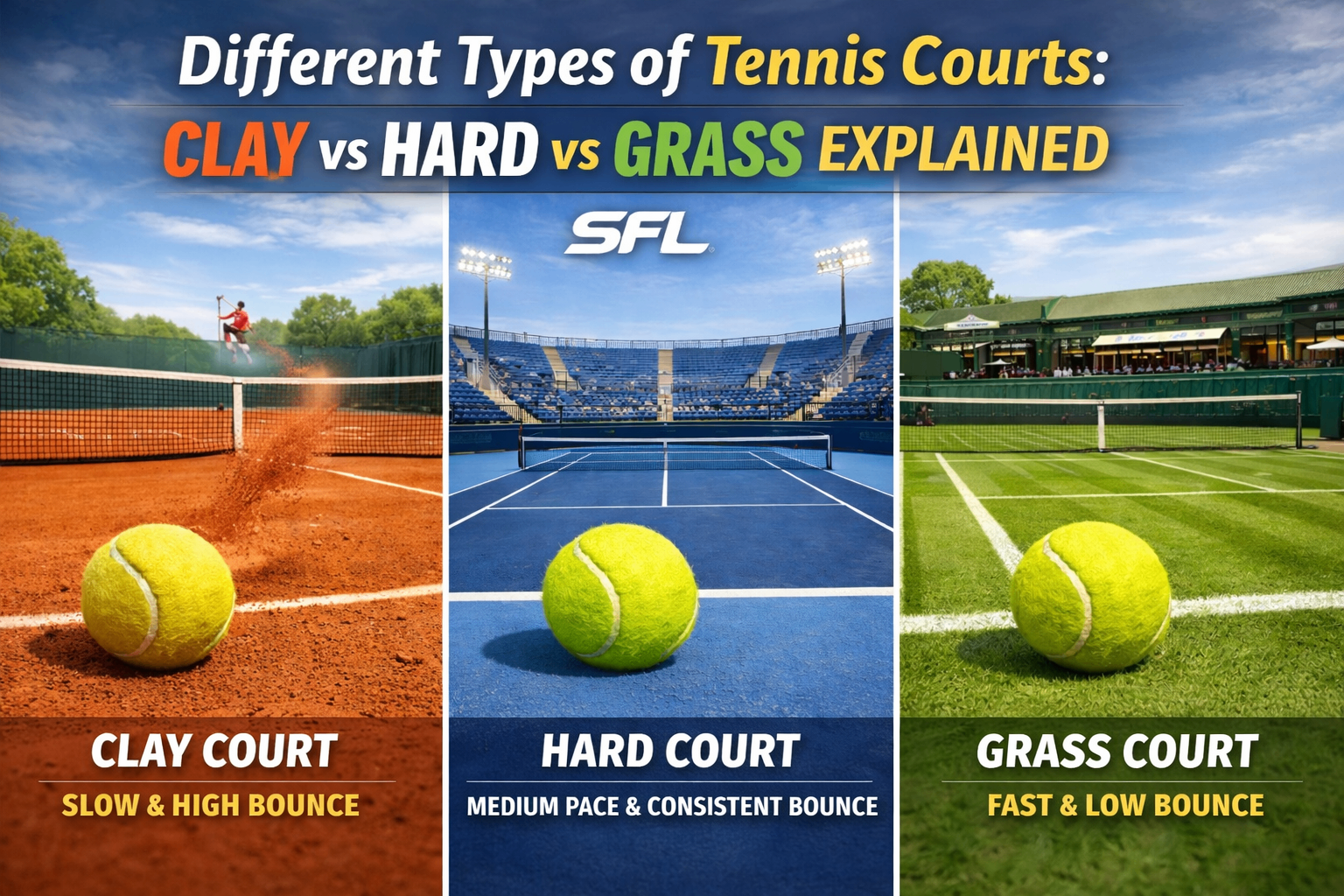
Each surface creates a different relationship between the ball, the player, and the court.
These differences affect how quickly the ball travels after bouncing, how high it rises, how players move, and which tactical decisions are most effective.
However, it would be misleading to describe every clay court as slow, every grass court as fast, or every hard court as identical.
Weather, maintenance, ball selection, surface composition, and playing conditions can all influence the pace of a match.
Understanding these details helps explain why certain players dominate particular tournaments and why winning across all three surfaces is one of tennis’s greatest achievements.
Why Tennis Court Surfaces Matter
At first glance, the rules of tennis remain the same regardless of the court.
The net has the same height, the court uses the same standard dimensions, and players compete under the same basic scoring system.
Yet the physical interaction between the ball and the ground changes the way points develop.
When a tennis ball strikes the court, several factors determine what happens next:
- The amount of friction between the ball and the surface.
- The angle at which the ball approaches the ground.
- The speed and spin of the incoming shot.
- The hardness and elasticity of the playing surface.
- The court’s condition and surrounding weather.
These variables affect both the speed and height of the bounce.
A player who understands these differences can adjust positioning, shot selection, and movement to gain an advantage.
Clay Courts: The Surface of Patience and Endurance
Clay courts are strongly associated with European tennis, particularly the French Open at Roland-Garros.
Despite their name, many professional red clay courts are constructed using layers of crushed stone, limestone, and crushed brick rather than natural clay alone.
The surface is covered with fine material that influences traction and ball behavior.
Clay is generally considered slower than traditional grass and many hard courts.
When the ball strikes the surface, friction tends to reduce its forward speed while allowing spin to influence the bounce.
As a result, players often have more time to react after the ball lands.
How the Ball Bounces on Clay
Clay courts commonly produce a relatively high bounce, particularly when players use heavy topspin.
A topspin shot rotates forward as it travels through the air.
When it strikes the clay, the interaction between spin and surface friction can cause the ball to rise sharply.
This can make attacking shots more difficult for opponents.
For example, a heavy topspin forehand directed toward an opponent’s backhand may force that player to strike the ball above shoulder height.
Such contact points can be uncomfortable and may reduce the opponent’s ability to attack.
Why Clay Produces Longer Rallies
Because clay often reduces the effectiveness of powerful first strikes, points can require additional shots.
A strong serve may still create an advantage, but the receiver often has more opportunity to return the ball.
Players who can defend consistently and maintain patience may therefore benefit.
However, successful clay-court tennis is not purely defensive.
Modern clay-court champions frequently use aggressive topspin, sharp angles, and controlled changes of direction to create opportunities.
Sliding on Clay
One of the most recognizable features of clay-court tennis is sliding.
Players can slide into a shot and use the movement to control their momentum.
When executed correctly, this technique helps them reach difficult balls while preparing for the next movement.
Sliding requires practice and precise balance.
A player who is unfamiliar with clay may struggle to stop efficiently or recover after a wide shot.
The Physical Demands of Clay Tennis
Clay-court matches often involve extended rallies and repeated changes of direction.
This places considerable demands on cardiovascular endurance and muscular stamina.
Players must remain mentally focused through points that can last much longer than those on faster surfaces.
However, the ability to slide can also change how braking forces are distributed during movement.
Clay is therefore not automatically easier or harder on the body; the demands depend on technique, conditioning, and playing style.
Rafael Nadal and the Art of Clay-Court Tennis
Rafael Nadal provides one of the clearest examples of how a playing style can be optimized for a particular surface.
The Spanish champion won 14 French Open singles titles, establishing an extraordinary record at Roland-Garros.
His success was based on several complementary strengths.
His left-handed forehand generated heavy topspin, creating high-bouncing shots that were difficult to attack.
His movement and sliding ability allowed him to defend wide areas of the court.
He also demonstrated exceptional patience, often constructing points over several shots before attacking.
However, Nadal’s achievements should not be reduced to the surface alone.
His tactical intelligence, competitive determination, and physical preparation were equally important.
He also won major championships on grass and hard courts, demonstrating that great players can adapt beyond their preferred conditions.
Grass Courts: Speed, Precision, and Quick Reactions
Grass is the oldest major surface associated with lawn tennis.
Wimbledon remains its most famous tournament.
Unlike clay, grass is a living surface that changes throughout a tournament.
The condition of the grass, the firmness of the soil beneath it, and the amount of wear can influence ball behavior.
Grass courts have traditionally been associated with fast play and relatively low bounces.
However, modern grass-court conditions vary, and Wimbledon is not necessarily as fast as it was during earlier periods.
How the Ball Behaves on Grass
Grass can produce a lower and sometimes less predictable bounce than other major surfaces.
The ball may stay relatively close to the ground, giving players less time to prepare their shots.
This can reward competitors who react quickly and strike the ball efficiently.
Flat shots, slices, and well-placed serves may be particularly effective.
However, grass-court speed is affected by more than the blades of grass.
The underlying soil, moisture, and firmness of the court all contribute to playing conditions.
Why Serving Is Important on Grass
A powerful, accurate serve can be especially effective when the ball stays low after bouncing.
The receiver may have limited time to react or establish an aggressive return position.
As a result, holding serve can become an important tactical priority.
Players who combine accurate serving with strong first shots often perform well.
However, serving alone is not enough.
Elite grass-court players must also return effectively, move efficiently, and handle low balls.
Serve-and-Volley Tennis
Grass courts were historically associated with serve-and-volley tactics.
Players would serve and immediately approach the net, attempting to finish the point with a volley.
The lower bounce and faster exchanges made this approach attractive.
Champions such as Pete Sampras and Stefan Edberg demonstrated the effectiveness of aggressive net play.
Modern grass-court tennis generally features more baseline rallies than earlier eras.
Changes in playing conditions, racket technology, returning ability, and tactical development have contributed to this evolution.
Roger Federer and Grass-Court Excellence
Roger Federer became one of the most successful grass-court players in tennis history.
He won eight Wimbledon men’s singles titles.
His game was particularly effective on grass because of his precise serving, efficient footwork, attacking forehand, and ability to take the ball early.
Federer could shorten points when necessary while remaining comfortable in baseline exchanges.
His slice backhand was also useful for keeping the ball low and disrupting opponents’ rhythm.
Federer’s success demonstrated that grass-court excellence requires more than raw serving power.
Timing, balance, variety, and tactical awareness can be equally important.
Hard Courts: The Most Versatile Major Surface
Hard courts are commonly constructed with an asphalt or concrete base covered by acrylic surface layers.
They are widely used in professional tournaments and recreational tennis facilities.
Two Grand Slam tournaments are played on hard courts: the Australian Open and the US Open.
However, hard courts are not all identical.
The composition of the surface coating, the amount of texture, and the underlying construction can influence the speed and height of the bounce.
How the Ball Bounces on Hard Courts
Hard courts generally provide a more consistent bounce than natural grass and many clay surfaces.
This predictability helps players time their groundstrokes.
However, the speed of a hard court can vary considerably.
Some courts allow the ball to retain more pace after bouncing.
Others create greater friction and slower playing conditions.
As a result, the term “hard court” describes a broad category rather than one exact playing speed.
Why Hard Courts Reward All-Round Players
Hard courts can support a wide range of playing styles.
Powerful servers may benefit from a reliable bounce.
Aggressive baseliners can use the predictable surface to control rallies.
Defensive players can also succeed through movement, returning, and consistency.
Because hard-court conditions vary, the most successful players often possess adaptable games.
Movement on Hard Courts
Traditional hard-court movement involves rapid acceleration, braking, and changes of direction.
Players generally rely more on controlled foot placement than the extended sliding commonly associated with clay.
However, some elite modern players have developed techniques that allow them to slide on hard courts.
These movements require exceptional balance, flexibility, and training.
The repetitive impact of hard-court tennis can place significant demands on the body, although injury risk depends on many factors beyond surface type.
Novak Djokovic and Hard-Court Dominance
Novak Djokovic provides a strong example of a player whose strengths are especially effective on hard courts.
His ten Australian Open men’s singles titles demonstrate his extraordinary success in Melbourne.
Djokovic’s return of serve is one of the most effective in tennis history.
His ability to absorb pace and redirect the ball makes him difficult to attack.
His movement and two-handed backhand allow him to control rallies from defensive positions.
On hard courts, the relatively predictable bounce supports his timing and ability to change direction.
However, Djokovic has also won major championships on clay and grass.
His career illustrates how an adaptable playing style can remain effective across all three surfaces.
Clay vs. Grass vs. Hard Courts: The Main Differences
The following comparison summarizes the general characteristics of the three surfaces.
| Characteristic | Clay | Grass | Hard Court |
|---|---|---|---|
| Typical pace | Generally slower | Often faster | Variable |
| Typical bounce | Higher, spin-sensitive | Lower, sometimes irregular | Relatively consistent |
| Common movement | Controlled sliding | Short adjustments and balance | Rapid stops and changes of direction |
| Tactical emphasis | Topspin, patience, point construction | Serving, timing, low-ball control | Balanced attacking and defending |
| Grand Slam example | French Open | Wimbledon | Australian Open, US Open |
These are general tendencies rather than fixed rules.
A well-maintained clay court may play differently from another clay court, while hard courts can range from relatively slow to very fast.
How Surface Speed Changes Tennis Strategy
Surface speed affects the amount of time players have to prepare for their next shot.
On faster courts, players may have less time to react after the ball bounces.
This can make serving, early ball striking, and efficient positioning especially important.
On slower courts, players may have more time to recover and construct points.
However, slower conditions can also create opportunities for aggressive players who use spin and angles effectively.
Attacking on Clay
On clay, a player may need to construct an opening through several shots.
Heavy topspin can push an opponent behind the baseline.
Once the opponent is out of position, the attacker can change direction or move forward.
Attacking on Grass
On grass, the opportunity to attack may appear earlier in a rally.
A well-placed serve or low slice can force a weak response.
Players must react quickly because the next shot may arrive with limited preparation time.
Attacking on Hard Courts
On hard courts, attacking strategies depend heavily on the specific court conditions.
Some surfaces reward powerful first strikes.
Others allow longer exchanges and more defensive recovery.
Adaptable players can adjust their approach according to the tournament.
How Topspin and Slice Behave on Different Surfaces
Spin plays an important role in modern tennis.
However, the effect of spin changes depending on the surface.
Topspin on Clay
Clay’s friction can make heavy topspin particularly effective.
The ball may rise sharply after bouncing, forcing opponents to make contact at uncomfortable heights.
This is one reason topspin-heavy players often perform well on clay.
Slice on Grass
Slice shots can be especially useful on grass because they may stay relatively low.
A low bounce can force opponents to bend and lift the ball, reducing their ability to attack.
However, slice effectiveness still depends on shot quality and court conditions.
Spin on Hard Courts
Hard courts can reward both topspin and slice.
The relatively predictable bounce allows players to use spin for tactical variety.
Topspin can create angles and control, while slice can change the rhythm of rallies.
Why Winning on All Three Surfaces Is Difficult
Winning major championships across clay, grass, and hard courts requires exceptional adaptability.
A player cannot rely on exactly the same tactics at every tournament.
Clay may demand greater patience and effective sliding.
Grass may require improved low-ball handling and quicker preparation.
Hard courts may demand a balance between aggressive shot-making and defensive consistency.
Players must also adjust their training and movement patterns during the season.
This is why completing the Career Grand Slam is such a significant achievement.
It demonstrates the ability to win all four major tournaments despite their different conditions.
The Career Grand Slam and Surface Versatility
A Career Grand Slam is achieved when a player wins all four Grand Slam singles tournaments at least once during a career.
In the modern era, this requires success on clay, grass, and hard courts.
Roger Federer, Rafael Nadal, and Novak Djokovic all completed the men’s singles Career Grand Slam.
Serena Williams also achieved the feat in women’s singles.
These players developed different strengths, but each demonstrated the versatility necessary to win across the major surfaces.
Their achievements show that the greatest players often adapt rather than depend entirely on their preferred conditions.
How Weather Changes Court Conditions
Weather can significantly affect how a tennis court plays.
Temperature
Temperature influences ball behavior and playing conditions.
Warmer conditions can change how the ball travels and rebounds, although the effect depends on the surface and other environmental factors.
Humidity and Moisture
Moisture can affect traction and surface firmness.
Grass courts may become slippery when wet, which is why professional matches are generally suspended when conditions become unsafe.
Clay courts also require careful moisture management to maintain consistent playing conditions.
Wind
Wind affects ball flight on every surface.
Players may need to adjust their toss, swing timing, and shot selection.
On windy days, consistency and tactical flexibility can become more important than raw power.
Indoor vs. Outdoor Hard Courts
Hard-court tennis can also differ between indoor and outdoor environments.
Indoor courts eliminate wind and reduce some weather-related variables.
This can make serving and aggressive shot-making more predictable.
Outdoor hard courts introduce additional challenges such as sunlight, wind, temperature changes, and humidity.
However, indoor courts are not automatically faster than outdoor courts.
The specific surface and ball conditions remain important factors.
Are Certain Tennis Surfaces More Dangerous?
Different surfaces create different physical demands.
Clay allows controlled sliding but often involves long rallies and repeated changes of direction.
Grass can create challenges related to traction and low-bouncing shots.
Hard courts involve frequent acceleration, braking, and impact.
However, it is difficult to conclude that one surface is universally safer or more dangerous.
Injury risk depends on training, footwear, technique, previous injuries, court condition, and workload.
Players benefit from adapting their movement and preparation to the surface rather than assuming one type of court is always preferable.
Which Surface Is Best for Beginners?
The best surface for a beginner depends on access, coaching, local facilities, and personal comfort.
Hard courts are common in many regions and often provide a consistent bounce that helps players practice timing.
Clay can encourage patience, footwork, and point construction.
Grass offers a different challenge, although well-maintained grass courts are less widely available.
For most beginners, consistent practice and appropriate coaching matter more than choosing a theoretically ideal surface.
How Professional Players Prepare for Surface Changes
Professional tennis players regularly move between tournaments played on different surfaces.
These transitions require technical and physical adjustments.
Before clay tournaments, players may emphasize sliding, endurance, and topspin patterns.
Before grass tournaments, they may focus on lower contact points, quick footwork, serving accuracy, and return positioning.
Hard-court preparation can involve adjusting to the speed and bounce of a particular venue.
Players also adapt their footwear and training routines to the conditions.
The ability to make these adjustments quickly is an important advantage during a long season.
The Grand Slam Calendar and Court Surfaces
The four Grand Slam tournaments provide the most visible examples of surface diversity in tennis.
| Tournament | Location | Surface |
|---|---|---|
| Australian Open | Melbourne, Australia | Hard court |
| French Open | Paris, France | Clay |
| Wimbledon | London, England | Grass |
| US Open | New York, United States | Hard court |
The different surfaces help create distinct tournament identities.
They also ensure that the most successful players must demonstrate a wide range of skills throughout the season.
Frequently Asked Questions About Tennis Court Surfaces
What are the three main tennis court surfaces?
The three major surfaces used at Grand Slam tournaments are clay, grass, and hard courts.
Which tennis surface is the fastest?
Grass is traditionally associated with fast play and low bounces, but actual court speed varies according to construction, maintenance, weather, and ball conditions.
Why is clay considered slower?
Clay typically creates more friction during the bounce, which can reduce the ball’s forward speed and make spin more influential.
Why do players slide on clay courts?
Sliding helps trained players manage momentum, reach difficult balls, and recover efficiently.
Are all hard courts the same speed?
No. Hard-court speed varies depending on surface composition, texture, construction, and environmental conditions.
Which Grand Slam is played on grass?
Wimbledon is the only Grand Slam tournament currently played on grass.
Which Grand Slam is played on clay?
The French Open at Roland-Garros is played on clay.
Why is Rafael Nadal so successful on clay?
His heavy topspin, exceptional movement, tactical patience, and competitive consistency made his game particularly effective on clay courts.
Can a player be successful on every surface?
Yes. Champions such as Roger Federer, Rafael Nadal, Novak Djokovic, and Serena Williams won major singles titles on clay, grass, and hard courts.
Conclusion: Different Surfaces, Different Versions of Tennis
Clay, grass, and hard courts do more than change the appearance of a tennis match. They influence its rhythm, tactics, movement, and physical demands.
Clay often rewards patience, heavy topspin, and effective sliding.
Grass frequently places greater emphasis on serving, timing, low-ball control, and quick reactions.
Hard courts offer a wide range of conditions and can reward players with balanced, adaptable games.
However, no surface can be reduced to a single playing style.
Modern tennis is shaped by court construction, maintenance, weather, ball selection, and the evolving skills of professional players.
The greatest champions succeed because they understand these differences and adjust their games accordingly.
For fans, recognizing how surfaces affect tennis adds another dimension to watching the sport.
A rally at Roland-Garros, a serving battle at Wimbledon, and a baseline exchange at the Australian Open may follow the same rules, but each reveals a different version of the game.
Leave a Reply