How Formula 1 Engines Work: Understanding Modern Power Units
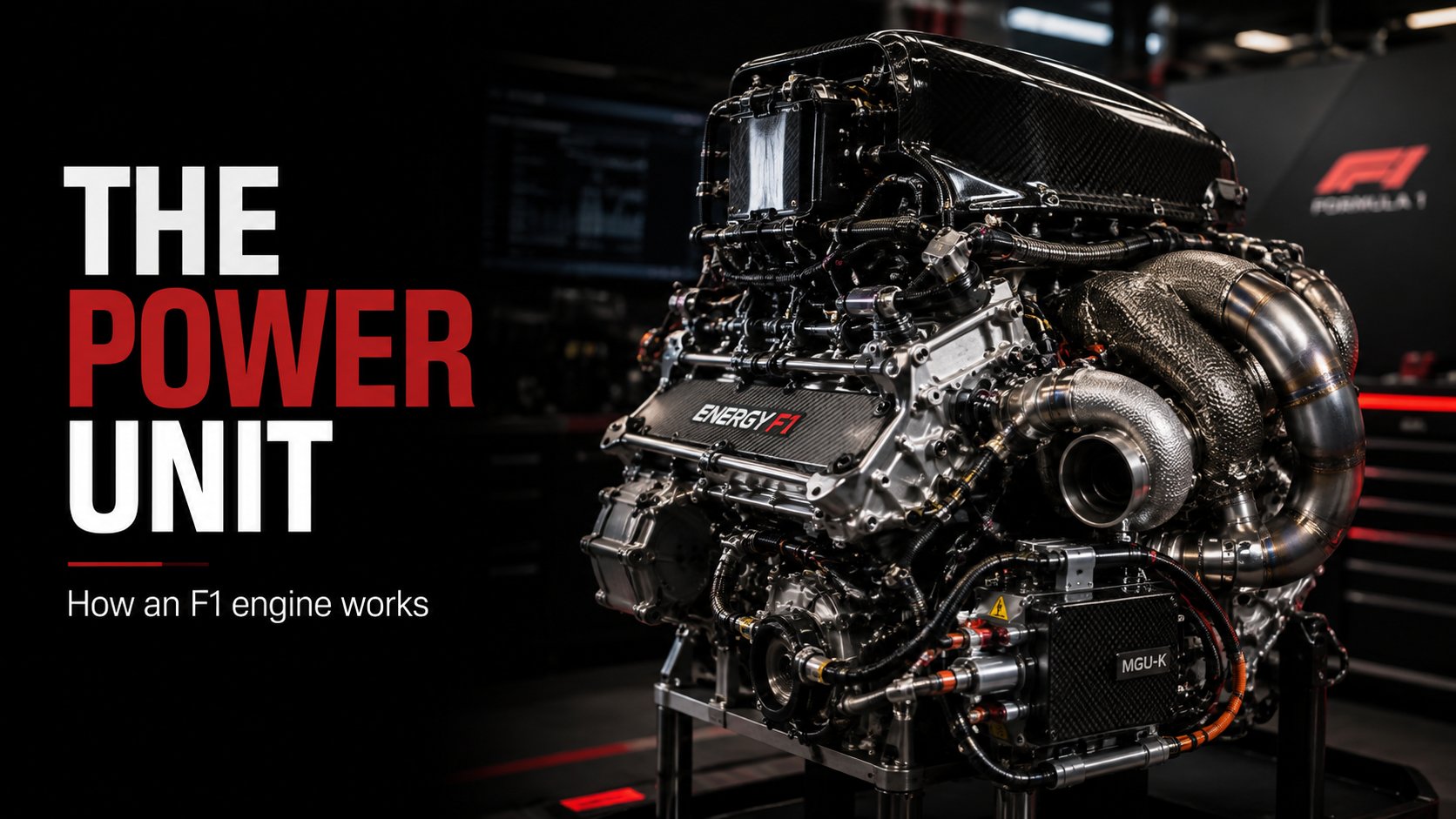
Many people still describe it simply as an engine. In reality, a modern Formula 1 car uses a complex hybrid system that combines a turbocharged internal combustion engine with electrical energy recovery and deployment.
The system does more than produce horsepower. It manages fuel consumption, converts braking energy into electricity, stores that electricity, and releases it when additional performance is needed.
The introduction of new Formula 1 power unit regulations in 2026 has made this relationship between combustion and electrical energy even more important.
Understanding how these systems work reveals why modern Formula 1 engineering is as much about energy management as it is about outright speed.
What Is a Formula 1 Power Unit?
In traditional automotive terminology, an engine converts fuel into mechanical power.
A Formula 1 power unit performs that task but also includes several additional systems responsible for recovering, storing, and deploying electrical energy.
The term “power unit” became especially important when Formula 1 introduced turbocharged hybrid regulations in 2014.
Rather than relying entirely on an internal combustion engine, cars began using a combination of mechanical and electrical power.
That basic philosophy continues under the 2026 regulations, although the technical architecture has changed significantly.
The modern system includes a turbocharged V6 engine, an electric motor-generator, an energy storage system, and electronic controls that coordinate how energy moves through the car.
Each component contributes to the car’s overall performance.
The combustion engine provides sustained mechanical power, while the electrical system can recover energy and deliver additional power when required.
The result is a racing powertrain that must balance speed, efficiency, reliability, and energy availability throughout a Grand Prix.
The Main Components of a Modern Formula 1 Power Unit
Although the technology is complicated, its essential components can be understood individually.
| Component | Primary Function |
|---|---|
| Internal Combustion Engine (ICE) | Converts fuel energy into mechanical power |
| Turbocharger | Uses exhaust energy to compress intake air |
| MGU-K | Recovers kinetic energy and supplies electrical power |
| Energy Store (ES) | Stores recovered electrical energy |
| Control Electronics (CE) | Coordinates electrical energy recovery and deployment |
| Fuel System | Delivers regulated fuel to the combustion engine |
These components do not operate independently.
Their performance depends on how effectively the entire system is integrated.
How the 1.6-Liter V6 Turbocharged Engine Works
At the center of the modern Formula 1 power unit is a 1.6-liter V6 internal combustion engine.
The engine contains six cylinders arranged in two banks forming a V-shaped configuration.
Each cylinder contains a piston that moves up and down as fuel and air are burned.
The movement of the pistons turns a crankshaft, converting combustion energy into rotational mechanical power.
This power ultimately reaches the rear wheels through the car’s transmission and drivetrain.
Despite its relatively small displacement, the engine produces exceptional performance because it operates under highly optimized conditions.
Advanced fuel injection, carefully controlled combustion, sophisticated cooling, and a turbocharger all contribute to its efficiency.
The Four-Stroke Combustion Cycle
The combustion engine operates through four fundamental stages.
- Intake: Air enters the cylinder through the intake valves.
- Compression: The piston compresses the air before combustion.
- Power: Fuel combustion increases pressure and forces the piston downward.
- Exhaust: Burned gases leave the cylinder through the exhaust valves.
This cycle repeats continuously while the engine is running.
At racing speeds, these events occur thousands of times per minute across the engine’s cylinders.
Engineers must carefully manage temperatures, pressures, friction, and component durability.
Even small improvements in combustion efficiency can make a meaningful difference over the distance of a race.
What Does the Turbocharger Do in Formula 1?
A turbocharger increases the amount of air entering the combustion engine.
It uses energy from the engine’s exhaust gases to spin a turbine.
That turbine drives a compressor, which increases the pressure of the incoming air.
By forcing more air into the engine, the turbocharger allows the combustion system to generate greater power than a naturally aspirated engine of similar displacement.
However, compressing air also increases its temperature.
Hotter air is less dense, which can reduce the amount of oxygen available for combustion.
Formula 1 power units therefore use sophisticated cooling systems to manage intake temperatures and maintain performance.
The turbocharger must also withstand extreme thermal and mechanical conditions.
Its design influences engine response, efficiency, packaging, and overall power delivery.
What Is Turbo Lag?
Turbo lag describes the delay between a driver’s request for additional power and the turbocharger reaching the operating conditions needed to provide it.
Traditional turbocharged engines can experience this delay because the turbine needs sufficient exhaust energy to accelerate.
Formula 1 engineers work to minimize these effects through turbocharger design, combustion control, and the coordination of electrical and mechanical power.
The removal of the MGU-H in 2026 also changes how manufacturers approach turbo response compared with the previous hybrid era.
How the MGU-K Recovers Energy
The Motor Generator Unit-Kinetic, commonly called the MGU-K, is one of the most important parts of the modern Formula 1 hybrid system.
Its name describes its two operating roles.
As a generator, it converts mechanical energy into electrical energy.
As a motor, it converts stored electrical energy back into mechanical power.
During braking, a Formula 1 car must reduce its speed rapidly.
In a conventional braking system, much of the vehicle’s kinetic energy becomes heat through friction.
The MGU-K allows part of that energy to be recovered rather than wasted.
When operating as a generator, it applies resistance through the drivetrain while producing electricity.
That electrical energy can then be stored for later use.
When the driver accelerates, the MGU-K can operate as a motor and provide additional power.
This makes braking zones important not only for slowing the car but also for replenishing electrical energy.
Why the 2026 MGU-K Is So Important
The 2026 Formula 1 power unit regulations significantly increased the importance of electrical propulsion.
Under the previous regulations, the MGU-K had a maximum output of 120 kilowatts.
For 2026, that figure increased to 350 kilowatts.
That is equivalent to approximately 469 mechanical horsepower from the electric motor at its maximum permitted output.
The larger electrical contribution means that teams must pay even closer attention to when energy is recovered and when it is deployed.
Drivers cannot simply use maximum electrical assistance continuously without considering the energy available.
Energy management therefore becomes an important part of racing strategy.
A driver may need to balance acceleration out of corners, power delivery along straights, and energy recovery during braking.
The electrical system is no longer a relatively small addition to the combustion engine.
It is a major contributor to the car’s total performance.
What Happened to the MGU-H?
Between 2014 and 2025, Formula 1 power units used another electrical component called the Motor Generator Unit-Heat, or MGU-H.
The MGU-H was connected to the turbocharger shaft.
It could recover energy associated with the turbocharger’s operation and use electrical power to help control turbo speed.
This provided opportunities to improve efficiency and reduce turbo lag.
However, the system was extremely complex and expensive to develop.
Under the 2026 power unit regulations, the MGU-H was removed.
Its removal was intended to simplify the power unit architecture and reduce barriers for manufacturers entering Formula 1.
The change also places greater emphasis on the MGU-K and the overall management of stored electrical energy.
Manufacturers must now achieve strong turbocharged engine performance without relying on the same electrical turbo control system used during the previous era.
How Formula 1 Batteries Store Energy
The energy storage system is another essential part of the hybrid power unit.
It stores electricity recovered by the MGU-K and makes that energy available for later deployment.
The battery is designed for extremely demanding operating conditions.
Unlike a conventional electric road car, a Formula 1 hybrid system must repeatedly accept and release significant amounts of power during a race.
This requires careful thermal management, precise electrical controls, and a design capable of handling repeated charging and discharging cycles.
Battery performance is not simply about total storage capacity.
Power density, energy density, cooling, weight, reliability, and packaging all matter.
A system that stores large amounts of energy but cannot deliver it quickly enough would be poorly suited to Formula 1.
Similarly, a battery that provides strong power output but overheats under racing conditions would compromise performance.
Engineers must therefore balance multiple competing requirements.
How Electrical Power Reaches the Wheels
When electrical assistance is required, energy moves from the battery through the power electronics to the MGU-K.
The MGU-K then operates as a motor, adding mechanical power to the drivetrain.
This additional power works alongside the combustion engine’s output.
The car’s control systems determine how the available energy can be used within the regulations.
For the driver, the result is a power delivery system that changes according to speed, available battery energy, and the operating strategy.
For the engineers, the challenge is to ensure that electrical assistance is available where it delivers the greatest benefit.
Deploying too much energy early in a lap may leave less available for later sections.
Using too little may sacrifice acceleration or straight-line performance.
The fastest strategy depends on the circuit, the car’s efficiency, and the race situation.
Why Formula 1 Uses Sustainable Fuel in 2026
Another major change introduced for 2026 concerns the fuel used by the internal combustion engine.
Formula 1’s new regulations require advanced sustainable fuel that meets the championship’s technical and sustainability criteria.
The objective is to reduce reliance on newly extracted fossil carbon while maintaining the high performance expected from Formula 1 engines.
Such fuels may be produced using approved sustainable feedstocks and manufacturing processes.
However, sustainable fuel does not mean that the combustion engine produces no carbon dioxide at the exhaust.
Carbon dioxide is still released when carbon-containing fuel is burned.
The sustainability objective concerns the fuel’s carbon sourcing and lifecycle impact rather than the complete elimination of tailpipe emissions.
Fuel chemistry also affects combustion efficiency, engine temperatures, and power delivery.
Manufacturers must therefore develop engines and fuels together to achieve competitive performance.
The relationship between fuel suppliers and power unit manufacturers has become an important part of Formula 1’s technical competition.
Formula 1 Power Units Before and After the 2026 Regulations
The following comparison highlights the main differences between the hybrid era introduced in 2014 and the regulations that began in 2026.
| Feature | 2014–2025 | 2026 Regulations |
|---|---|---|
| Combustion Engine | 1.6-liter turbocharged V6 | 1.6-liter turbocharged V6 |
| Hybrid System | MGU-K and MGU-H | MGU-K; MGU-H removed |
| Maximum MGU-K Power | 120 kW | 350 kW |
| Electrical Contribution | Smaller proportion of total output | Much larger proportion of total output |
| Fuel | Regulated racing gasoline with increasing renewable content | Advanced sustainable fuel meeting 2026 requirements |
| Engineering Focus | Combustion efficiency and integrated hybrid performance | Greater electrical deployment, energy recovery, and sustainable fuel integration |
The transition does not mean Formula 1 has abandoned combustion engines.
Instead, the championship has changed the balance between combustion and electrical power.
How Much Horsepower Does a Modern Formula 1 Engine Produce?
Modern Formula 1 cars produce extraordinary power relative to their engine displacement.
However, quoting one universal horsepower figure can be misleading.
Exact performance varies between manufacturers, and teams do not publicly disclose every technical detail.
The 2026 regulations target a much more balanced contribution between combustion and electrical power than the previous generation.
The MGU-K can deliver up to 350 kilowatts, while the combustion engine provides the remaining major share of the power unit’s output.
Combined performance depends on the engine’s operating conditions and the electrical energy available for deployment.
It is also important to distinguish maximum theoretical output from the power available throughout an entire lap.
Electrical assistance is subject to energy management and regulatory limits.
A Formula 1 car therefore does not necessarily deliver its maximum combined output continuously.
Why Formula 1 Cars Need Sophisticated Cooling
Producing large amounts of power generates significant heat.
The combustion engine, turbocharger, electrical systems, and battery all operate within carefully controlled temperature ranges.
Excessive temperatures can reduce performance, damage components, or cause reliability problems.
Formula 1 cars use radiators, heat exchangers, coolant circuits, and airflow management to control thermal conditions.
Cooling systems must be effective without creating unnecessary aerodynamic drag.
This creates an engineering compromise.
Larger cooling openings may improve thermal performance but can reduce aerodynamic efficiency.
Smaller openings may improve airflow around the car but increase the risk of overheating.
Teams adjust cooling configurations according to circuit characteristics and environmental conditions.
Hot races, high-altitude circuits, and tracks with limited airflow can create different cooling challenges.
How Drivers Manage Energy During a Race
Formula 1 drivers must do more than steer, brake, and accelerate.
They also operate within an energy management strategy designed to maximize performance across a lap or race stint.
The car’s control systems manage much of the complexity, but the driver still influences how energy is used.
Braking behavior affects how much energy can be recovered.
Acceleration demands influence how quickly stored energy is consumed.
Race circumstances can also change the ideal strategy.
A driver defending a position may need to prioritize electrical deployment in different sections of a circuit than a driver running in clean air.
Similarly, a driver attempting an overtake may benefit from saving energy for a particular straight.
The challenge is to avoid sacrificing too much performance elsewhere on the lap.
Efficient energy management is therefore a combination of engineering preparation, software control, and driver execution.
Why Two Formula 1 Power Units Can Perform Differently
Formula 1 manufacturers operate under the same technical regulations, but their power units are not necessarily identical in performance.
Engineering teams make different decisions about combustion efficiency, turbocharger design, electrical systems, cooling, packaging, and control strategies.
These decisions influence how the power unit behaves.
One design may deliver strong acceleration under particular conditions, while another may offer advantages in energy efficiency or thermal management.
Reliability is another critical factor.
A powerful engine provides little benefit if it frequently fails to finish races.
Manufacturers must also consider how the power unit integrates with the chassis.
Cooling requirements, component placement, and weight distribution can affect the entire car’s aerodynamic and mechanical performance.
Consequently, the most successful power unit is not always the one with the highest isolated engine output.
It is the one that contributes most effectively to the complete racing package.
What Makes Formula 1 Engines Different From Road Car Engines?
Both Formula 1 engines and conventional road car engines rely on fundamental mechanical principles.
However, their design priorities differ significantly.
Road car engines must balance performance with affordability, comfort, emissions compliance, durability, and everyday usability.
Formula 1 power units are developed primarily for competition within strict technical regulations.
They use specialized materials, sophisticated electronics, and advanced manufacturing methods to achieve exceptional performance.
Formula 1 also operates under demanding component allocation rules, meaning reliability remains essential despite the extreme operating conditions.
Another difference is the level of integration.
In Formula 1, the power unit is developed as part of a complete vehicle system in which aerodynamics, cooling, weight, and energy management are closely connected.
Nevertheless, some principles developed through motorsport can influence road vehicle technology.
These include energy recovery, efficient combustion, hybrid control strategies, and advanced thermal management.
Does Formula 1 Technology Influence Everyday Cars?
Formula 1 has long served as a testing environment for advanced automotive engineering.
Not every racing innovation transfers directly to road vehicles.
However, the sport provides opportunities to explore technologies under demanding conditions.
Hybrid energy recovery is one area with clear conceptual similarities to road car development.
Many hybrid and electric vehicles use regenerative braking to recover energy that would otherwise be lost as heat.
Formula 1 applies the same broad principle under much more extreme performance requirements.
Advances in battery management, power electronics, simulation, and combustion efficiency may also contribute knowledge relevant to the wider automotive industry.
The 2026 sustainable fuel regulations create another area of potential technological interest.
However, the commercial value and environmental benefits of any technology depend on how it is produced, scaled, and used outside racing.
Frequently Asked Questions About Formula 1 Engines
What engine does Formula 1 use in 2026?
Formula 1 uses a 1.6-liter turbocharged V6 hybrid power unit under the 2026 regulations.
Are Formula 1 cars hybrid?
Yes. Modern Formula 1 cars combine an internal combustion engine with an electrical energy recovery and deployment system.
What does MGU-K mean?
MGU-K stands for Motor Generator Unit-Kinetic. It recovers energy during braking and can use stored electrical energy to provide additional mechanical power.
What happened to the MGU-H in 2026?
The MGU-H was removed from Formula 1 power units under the 2026 technical regulations.
How much power can the 2026 MGU-K produce?
The 2026 MGU-K has a maximum permitted output of 350 kilowatts, approximately 469 mechanical horsepower.
Do Formula 1 engines use turbochargers?
Yes. Modern Formula 1 power units use turbochargers to increase the amount of air entering the combustion engine.
Do Formula 1 cars have batteries?
Yes. Their energy storage systems hold electrical energy recovered by the hybrid system for later deployment.
Why do Formula 1 cars recover energy during braking?
Energy recovery allows part of the car’s kinetic energy to be converted into electricity instead of being entirely dissipated as heat.
Do Formula 1 cars use sustainable fuel?
Yes. The 2026 regulations require advanced sustainable fuel meeting Formula 1’s technical and sustainability standards.
Are Formula 1 engines fully electric?
No. Formula 1 continues to use internal combustion engines alongside electrical hybrid systems.
Why is energy management important in Formula 1?
Electrical energy is limited, so teams must decide how to recover and deploy it effectively across different sections of a circuit.
Do all Formula 1 teams use the same engine?
No. Formula 1 includes different power unit manufacturers, although some teams use customer power units supplied by the same manufacturer.
Conclusion: Modern Formula 1 Is About More Than Engine Power
Modern Formula 1 power units demonstrate how racing technology has evolved beyond the traditional idea of an engine producing as much horsepower as possible.
The 1.6-liter turbocharged V6 remains central to the car’s performance, but electrical energy recovery and deployment now play an equally important strategic role.
The MGU-K converts braking energy into useful electricity, the energy storage system makes that power available for later use, and sophisticated control electronics coordinate the entire process.
The 2026 regulations have strengthened the role of electrical power while removing the MGU-H and introducing advanced sustainable fuel requirements.
These changes create new engineering challenges for manufacturers and new strategic considerations for drivers.
Ultimately, Formula 1 power unit performance depends on more than maximum output.
Efficiency, reliability, cooling, energy recovery, and integration with the chassis all influence how quickly a car can complete a lap.
The most important lesson is that modern Formula 1 engines do not simply produce power. They continuously manage how energy is created, recovered, stored, and used to achieve maximum racing performance.
Leave a Reply