How Professional Mobile Legends Teams Build Winning Draft Strategies
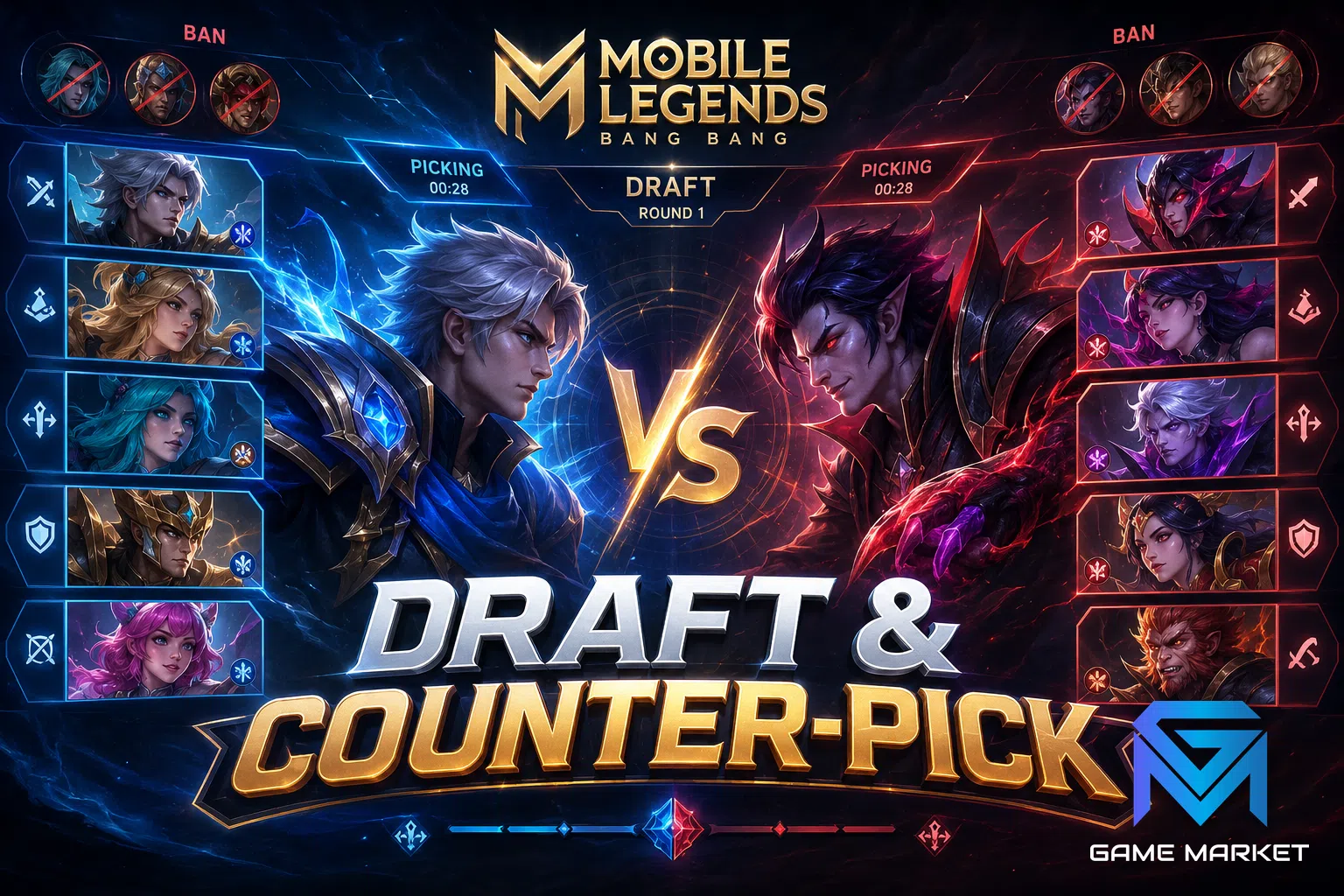
Image source: GameMarket.gg
Professional drafting is considerably more complicated.
Coaches and players must consider hero matchups, team composition, objective control, player comfort, and the strategies their opponents are likely to use.
They also need to think about what happens later in the match.
A composition that dominates the opening minutes may struggle when the opposing team’s damage dealers reach their strongest equipment timings.
Another lineup may possess excellent late-game potential but lack the tools needed to survive early pressure.
Successful drafting therefore involves balancing immediate advantages with a clear plan for winning the game.
Understanding this process reveals why professional Mobile Legends is not simply a contest of mechanical skill.
What Is Drafting in Professional Mobile Legends?
Drafting is the competitive process through which teams ban and select heroes before a match begins.
In professional Mobile Legends, the drafting phase follows the rules established for the tournament and its current competitive format.
Each team attempts to assemble a five-hero composition while limiting the options available to its opponent.
However, the objective is not simply to select five individually powerful heroes.
Teams need heroes whose abilities complement one another.
They must also ensure that their composition can contest objectives, defend important areas, and respond to the opposing lineup.
A well-designed draft usually has a recognizable strategic purpose.
For example, one team may prioritize early aggression and jungle control.
Another may focus on team-fight coordination around major objectives.
A third may build around strong late-game damage and defensive protection.
Each approach can work, but its effectiveness depends on execution and the opponent’s response.
Why Drafting Matters at the Professional Level
Professional players generally possess strong mechanical skills and extensive knowledge of the game.
As a result, matches are often decided by smaller advantages than those seen in ordinary ranked games.
Drafting can create some of these advantages before the match begins.
A favorable matchup may allow a laner to pressure an opponent more effectively.
A composition with strong crowd control may create opportunities to eliminate important targets.
A team with reliable objective damage may have an advantage when contesting Turtle or Lord.
However, drafting cannot guarantee victory.
Even an excellent composition can lose through poor positioning, missed skill combinations, or ineffective map decisions.
The value of a strong draft is that it gives players a coherent plan and suitable tools for executing it.
Step One: Understanding the Current Meta
Professional draft preparation begins with understanding the current meta.
The term meta generally refers to the strategies, heroes, and gameplay approaches considered effective in the present competitive environment.
Mobile Legends changes regularly through balance adjustments, hero updates, equipment changes, and other gameplay modifications.
These updates can influence which heroes are prioritized in professional matches.
A hero that was highly effective during one tournament may become less attractive after a significant balance change.
Likewise, changes to equipment or jungle mechanics can alter the value of certain team compositions.
Professional teams therefore cannot rely exclusively on strategies that worked several months earlier.
They must evaluate how the current version of the game affects their preferred playstyles.
How Teams Identify Strong Heroes
Coaching staff and players study several factors when evaluating hero strength.
- Performance in the current game version
- Effectiveness against commonly selected opponents
- Synergy with other priority heroes
- Flexibility across different team compositions
- Reliability during early and late-game situations
- Comfort and experience of the available players
However, a hero’s popularity does not automatically make it the correct choice for every team.
Professional drafting requires understanding why a hero is effective and whether the roster can use it successfully.
Step Two: Studying the Opponent Before the Match
One of the most important parts of professional drafting happens before tournament day.
Teams review previous matches to understand their opponents’ tendencies.
This preparation is commonly described as scouting.
Coaches may examine which heroes an opponent frequently selects, how the team approaches early objectives, and whether particular players perform especially well on certain characters.
They may also study how the opponent responds when preferred heroes are unavailable.
For example, a team might rely heavily on a specific jungle hero to establish early pressure.
If that hero is banned, the team may need to adopt a different approach.
However, removing one preferred hero is not always enough to disrupt an experienced opponent.
Strong professional players usually prepare alternative selections.
Effective scouting therefore focuses on broader patterns rather than isolated hero preferences.
Step Three: Building a Ban Strategy
Banning is one of the most direct ways to influence the opposing team’s options.
During the draft, teams can remove selected heroes from availability according to the tournament’s rules.
However, professional bans serve different purposes.
Target Bans
A target ban removes a hero strongly associated with a particular opponent.
This approach may be useful when a player has demonstrated exceptional performance with a specific character.
However, it can become ineffective if the opponent has several reliable alternatives.
Meta Bans
A meta ban removes a hero considered particularly strong in the current competitive environment.
Teams may use these bans when they do not want to leave an opponent access to a high-priority selection.
The decision depends on whether the team can counter the hero or use it effectively themselves.
Composition Bans
Composition bans attempt to weaken a particular strategic approach.
For example, a team may remove a hero that provides an important initiation tool for the opponent’s preferred team-fight composition.
This type of ban requires understanding how different heroes work together.
Protective Bans
Protective bans remove heroes that threaten a team’s intended strategy.
If a composition relies heavily on a vulnerable damage dealer, the team may attempt to eliminate an especially dangerous counter.
However, banning every possible counter is rarely realistic.
Teams must decide which threats deserve the highest priority.
Step Four: Choosing a Clear Team Identity
One common drafting mistake is selecting individually strong heroes without considering how they function together.
Professional teams generally attempt to establish a coherent composition.
That composition should answer several questions.
How will the team initiate fights?
Who provides reliable damage?
Which heroes can protect vulnerable teammates?
How will the team contest major objectives?
Does the lineup perform better early or late in the match?
The answers help determine whether the draft has a practical win condition.
Common Team Composition Strategies
Professional Mobile Legends teams can use several broad drafting approaches.
These categories are useful for understanding strategy, although actual tournament compositions often combine elements from multiple styles.
Early-Game Aggression
Early-game compositions attempt to establish an advantage before opposing heroes reach their strongest stages.
They may prioritize mobility, early damage, and the ability to contest jungle resources.
The objective is to create pressure that leads to favorable map control and objective opportunities.
However, these compositions can become less effective if the opponent successfully delays the match.
Team-Fight Composition
Team-fight compositions focus on coordinated engagements involving several heroes.
They often rely on crowd control, area damage, and abilities that work effectively when combined.
These lineups can be particularly dangerous around Turtle, Lord, and narrow jungle entrances.
However, they may struggle against opponents who avoid direct engagements or spread pressure across the map.
Pick-Off Composition
Pick-off compositions attempt to eliminate isolated opponents before a larger fight begins.
They often rely on mobility, vision control, and coordinated burst damage.
Successfully removing one opponent can create an opportunity to secure an objective.
However, pick-off strategies become difficult when the opposing team maintains disciplined positioning.
Late-Game Scaling
Scaling compositions prioritize heroes that become increasingly effective as they gain levels and equipment.
These lineups may accept a slower early game in exchange for stronger late-game potential.
However, they must survive long enough to reach their preferred power spikes.
Teams using scaling strategies therefore need effective defensive coordination and wave management.
Split-Push and Map Pressure
Some compositions emphasize mobility and pressure across multiple lanes.
Rather than committing every player to the same location, the team attempts to create difficult decisions for the opponent.
However, split-push strategies require strong map awareness.
Players can become vulnerable if they push too far without information about enemy positions.
Step Five: Balancing the Five Roles
Professional Mobile Legends compositions generally account for five primary roles: EXP lane, Gold lane, Mid lane, Jungle, and Roam.
Each role contributes different responsibilities.
However, the exact function of a hero depends on the team composition.
EXP Lane
EXP laners often contribute durability, side-lane pressure, initiation, or sustained damage.
Their role becomes particularly important during team fights and objective contests.
Some EXP heroes are effective at entering fights, while others excel at controlling space or pressuring isolated opponents.
Gold Lane
Gold laners frequently serve as important damage sources as the match progresses.
Many compositions rely on their ability to deal consistent damage during team fights.
However, these heroes may require protection against assassins and aggressive initiators.
Mid Lane
Mid laners contribute damage, crowd control, wave clearing, and rotational support.
Their positioning can influence how effectively the team moves between lanes and objectives.
A strong mid-lane selection should fit the team’s intended engagement style.
Jungle
Junglers play a major role in securing neutral objectives and establishing map pressure.
Different jungle heroes provide different strengths, including burst damage, mobility, durability, or sustained fighting.
Choosing a jungler affects how the team approaches early skirmishes and objective contests.
Roam
Roamers often provide initiation, vision, protection, or crowd control.
Their responsibilities can influence the entire team’s positioning.
A composition with limited initiation may need a roamer capable of starting engagements.
Another lineup may benefit more from defensive support.
Step Six: Understanding Counterpicks
Counterpicking involves selecting a hero or composition intended to exploit an opponent’s weaknesses.
However, a counterpick is not automatically effective simply because one hero has favorable abilities against another.
Professional teams must consider the full composition.
A hero may perform well in a direct lane matchup but struggle against the opponent’s broader team-fight strategy.
Likewise, a character that can threaten an enemy damage dealer may be difficult to use if the opposing lineup provides strong protection.
Effective counterpicking requires evaluating both individual matchups and overall team synergy.
Countering Mobility
Teams may prioritize reliable crowd control against compositions built around highly mobile heroes.
However, the effectiveness of crowd control depends on timing and positioning.
Countering Burst Damage
Defensive tools, protective abilities, and careful positioning can help reduce the impact of burst-oriented compositions.
Teams may also attempt to prevent opponents from reaching vulnerable targets.
Countering Heavy Frontlines
Compositions facing durable opponents may need sustained damage, appropriate equipment, and effective target selection.
Simply selecting additional damage dealers does not guarantee success if the team lacks protection or coordination.
Step Seven: Using Flex Picks to Create Uncertainty
Flex picks are heroes that can be used effectively in more than one role or strategic function.
They can make drafting more difficult for the opposing team because their final assignment may remain uncertain.
For example, a hero that can operate in multiple positions may prevent the opponent from immediately identifying the intended lane matchup.
This uncertainty can influence later bans and selections.
However, flexibility has practical limits.
A hero may technically be playable in several roles without being equally effective in all of them.
Professional teams must ensure that the relevant players can execute each possible assignment.
Otherwise, a supposed flex pick may create more problems than advantages.
Step Eight: Protecting the Team’s Win Condition
A win condition is the strategic situation a team wants to create to improve its chances of victory.
For example, a composition may depend on a late-game damage dealer surviving long enough to become effective.
Another may rely on securing early objectives and maintaining map pressure.
Professional teams must identify these conditions during drafting.
They then select heroes that support the intended plan.
If the team wants to protect a vulnerable damage dealer, it may prioritize defensive crowd control or frontline durability.
If the team intends to play aggressively, it may choose heroes capable of rotating quickly and contesting early resources.
However, the composition must also remain adaptable.
Opponents can disrupt even carefully prepared strategies.
Step Nine: Planning for Turtle and Lord
Major neutral objectives are central to professional Mobile Legends strategy.
The Turtle provides valuable early-game benefits, while Lord can help teams pressure enemy structures.
Drafting influences how effectively a team can contest these objectives.
Teams need to consider damage output, crowd control, positioning, and the ability to control nearby areas.
A lineup with strong objective damage may still struggle if it cannot safely enter the relevant part of the map.
Likewise, a team with powerful team-fight abilities may fail to secure an objective if its jungler is eliminated at the wrong moment.
Professional drafting therefore considers how heroes interact around objectives rather than evaluating each character independently.
Step Ten: Preparing Different Drafts for a Series
Professional Mobile Legends tournaments frequently use best-of-three, best-of-five, or best-of-seven match formats.
These series create additional strategic challenges.
A team cannot assume that one successful composition will remain effective throughout the entire matchup.
Opponents can identify weaknesses and adjust their selections.
Coaches must therefore prepare alternative approaches.
They may change jungle priorities, introduce different team-fight tools, or adjust their ban strategy.
Some tournament formats also introduce special drafting restrictions, such as hero reuse limitations.
When these rules apply, teams must plan their hero selections across the entire series rather than treating every game independently.
This makes roster depth and hero flexibility especially valuable.
How Coaches and Analysts Influence Drafting
Drafting is not solely the responsibility of the players.
Professional coaching staff often contribute to strategic preparation and draft planning.
Analysts may review match recordings, identify opponent tendencies, and evaluate the effectiveness of different compositions.
Coaches help translate that information into practical decisions.
However, player input remains essential.
A theoretically strong composition may be difficult to execute if the players are uncomfortable with the selected heroes.
Effective drafting therefore requires communication between coaching staff and the roster.
Teams must balance analytical preparation with practical experience.
The Role of Scrims in Draft Preparation
Scrims, or practice matches, allow professional teams to test strategies against organized opponents.
These sessions can help identify whether a composition performs as expected.
Teams may experiment with different hero combinations, early rotations, or objective setups.
However, scrim results require careful interpretation.
A strategy that succeeds during practice may perform differently under tournament pressure.
Opponents may also approach scrims differently from official matches.
Professional teams therefore use practice results as one source of information rather than treating them as definitive proof that a draft will succeed.
How Professional Teams Evaluate a Draft
Before finalizing a composition, teams can evaluate several important factors.
| Draft Factor | Key Question | Why It Matters |
|---|---|---|
| Hero Comfort | Can the player execute this hero consistently? | Reduces execution risks |
| Team Synergy | Do the heroes work effectively together? | Improves coordinated play |
| Early Game | Can the lineup survive or contest early pressure? | Influences initial map control |
| Late Game | How does the composition perform after scaling? | Determines long-match potential |
| Objective Control | Can the team contest Turtle and Lord? | Supports map pressure and progression |
| Counterplay | Can the opponent exploit a major weakness? | Helps prevent unfavorable matchups |
| Win Condition | What is the team’s clearest path to victory? | Creates strategic direction |
No single factor guarantees success.
The goal is to build a composition that provides a realistic and coordinated plan against the specific opponent.
Example: Building a Team-Fight Draft
Consider a hypothetical professional team preparing a composition focused on coordinated engagements.
The team may begin by selecting a roamer with reliable initiation.
It could then prioritize a mid-lane hero capable of following that initiation with area damage or additional crowd control.
The EXP laner may provide durability and help control the frontline.
The jungler must contribute objective control while fitting the team’s engagement pattern.
Finally, the Gold laner provides a reliable source of sustained damage.
On paper, this creates a composition capable of contesting major objectives through coordinated team fights.
However, the opponent may respond with mobility, disengagement tools, or pressure across multiple lanes.
The team must therefore consider whether its draft can force favorable engagements or adapt when opponents refuse to fight directly.
Example: Building an Early-Game Pressure Draft
Another hypothetical team may prefer aggressive early-game strategies.
Its draft could prioritize a jungler capable of contesting resources quickly.
The mid laner and roamer would need to support rotations and create pressure around the map.
Side-lane selections should be capable of surviving independently or contributing to early skirmishes.
The objective would be to establish an advantage before the opposing composition reaches its strongest stage.
However, this approach creates a clear risk.
If early aggression fails, the team may struggle against an opponent with stronger late-game damage.
The draft must therefore provide enough flexibility to recover from unsuccessful opening plays.
Common Drafting Mistakes in Competitive Mobile Legends
Even experienced teams can make mistakes during the drafting phase.
Choosing Too Many Heroes With Similar Weaknesses
A composition containing several vulnerable damage dealers may struggle against aggressive initiation.
Teams need to consider whether they have enough defensive tools.
Ignoring Objective Control
A lineup may possess strong fighting abilities but lack the tools needed to secure neutral objectives consistently.
This can make it difficult to convert successful engagements into meaningful advantages.
Overcommitting to the Early Game
Early pressure can be effective, but a composition that lacks late-game options may become vulnerable if the match continues longer than expected.
Overvaluing Individual Hero Strength
Powerful heroes do not automatically create a strong composition.
Teams must evaluate synergy and strategic purpose.
Ignoring Player Comfort
A theoretically favorable hero may become ineffective if the player lacks sufficient experience.
Professional drafting must account for execution.
Failing to Adapt Between Games
Repeating the same strategy without considering the opponent’s adjustments can make a team predictable.
Successful series preparation requires flexibility.
How Teams Like RRQ, ONIC, and EVOS Approach Drafting
Major Indonesian organizations such as RRQ, ONIC, and EVOS have competed in environments where drafting and preparation are essential.
However, their exact approaches vary depending on the roster, coaching staff, game version, and opponent.
It would be inaccurate to describe any organization as permanently committed to one drafting style.
Professional teams regularly adjust their priorities as the meta changes.
A lineup built around a mechanically aggressive jungler may prefer different compositions from one that emphasizes coordinated team fights.
Similarly, roster changes can influence which heroes are available and how comfortable players feel with particular strategies.
For viewers, the most useful approach is to analyze each draft within its competitive context.
Rather than assuming a team always plays one way, consider what its current lineup is attempting to accomplish.
Why a Winning Draft Can Still Lose
One of the most important principles in professional Mobile Legends is that drafting creates possibilities rather than guaranteed outcomes.
A composition may appear favorable because it has strong matchups, effective crowd control, and reliable objective damage.
However, the team still needs to execute its strategy.
Players must manage minion waves, maintain vision, coordinate rotations, and make correct decisions during fights.
A single mistake near Lord can change the outcome of a closely contested game.
Likewise, an opponent may identify an unexpected weakness and exploit it through superior positioning.
Drafting should therefore be evaluated alongside gameplay execution.
It is one important part of the competitive process, not a substitute for performance.
What Ranked Players Can Learn From Professional Drafting
Professional draft strategies can provide useful lessons for ordinary Mobile Legends players.
However, ranked matches differ from organized professional competition.
Teams may have less communication, different levels of hero familiarity, and fewer opportunities to coordinate complex strategies.
As a result, copying a professional composition does not guarantee success.
The more valuable approach is to understand the principles behind the draft.
Players can improve their decisions by considering team balance, damage distribution, crowd control, and the opposing lineup’s strengths.
They should also prioritize heroes they can play effectively.
A familiar hero that fits the team may be more useful than an unfamiliar character selected only because it appeared in a professional tournament.
Frequently Asked Questions About Mobile Legends Draft Strategies
What is a draft strategy in Mobile Legends?
A draft strategy is the plan a team uses to ban and select heroes before a match, with the goal of creating a composition that supports its intended approach.
Why is drafting important in professional MLBB?
Drafting influences hero matchups, team synergy, objective control, and the strategies available to both teams.
What is a counterpick?
A counterpick is a hero selection intended to exploit weaknesses in an opposing hero or team composition.
What is a flex pick?
A flex pick is a hero that can perform effectively in multiple roles or strategic functions, making its intended assignment harder to predict.
What does meta mean in Mobile Legends?
The meta refers to strategies, heroes, and gameplay approaches considered effective in the current competitive environment.
Why do professional teams ban certain heroes?
Teams may ban heroes because they are strong in the current meta, threaten an intended strategy, or are particularly effective when used by an opponent.
Does the first pick always have an advantage?
No. Early selection can secure a priority hero, but later selections may provide opportunities to counter the opposing composition.
Can a team win with an unusual draft?
Yes. Unconventional compositions can succeed when they have a clear purpose and are executed effectively. However, unusual selections also carry risks.
What is the most important role in drafting?
No single role is universally the most important. Draft priorities depend on the composition, current meta, and intended win condition.
How do professional teams prepare drafts?
They study opponents, analyze the current game version, review tournament matches, test strategies in scrims, and coordinate decisions between players and coaches.
Why do professional teams change drafts between games?
Teams adapt to opponent strategies, previous results, player performance, and tournament-specific drafting restrictions.
Can ranked players use professional draft strategies?
Yes. Ranked players can apply principles such as team balance, counterpicking, and objective control, although professional compositions may require more coordination than ordinary ranked matches provide.
Conclusion: Winning Drafts Begin With a Clear Plan
Professional Mobile Legends drafting is a complex process that combines preparation, strategic understanding, and player experience.
Teams must evaluate the current meta, study their opponents, select appropriate bans, and build compositions that support a clear win condition.
They also need to balance hero comfort, team synergy, objective control, and the ability to respond to unexpected situations.
However, drafting alone does not determine the result.
Even a carefully prepared composition requires strong communication and effective execution.
The most successful teams understand that the draft is the beginning of a strategy rather than the strategy’s final achievement.
In professional Mobile Legends, a winning draft is not simply a collection of powerful heroes. It is a coordinated plan that gives five players the tools to compete effectively as one team.
Leave a Reply