How Formula 1 Engines Work: Understanding Modern Power Units
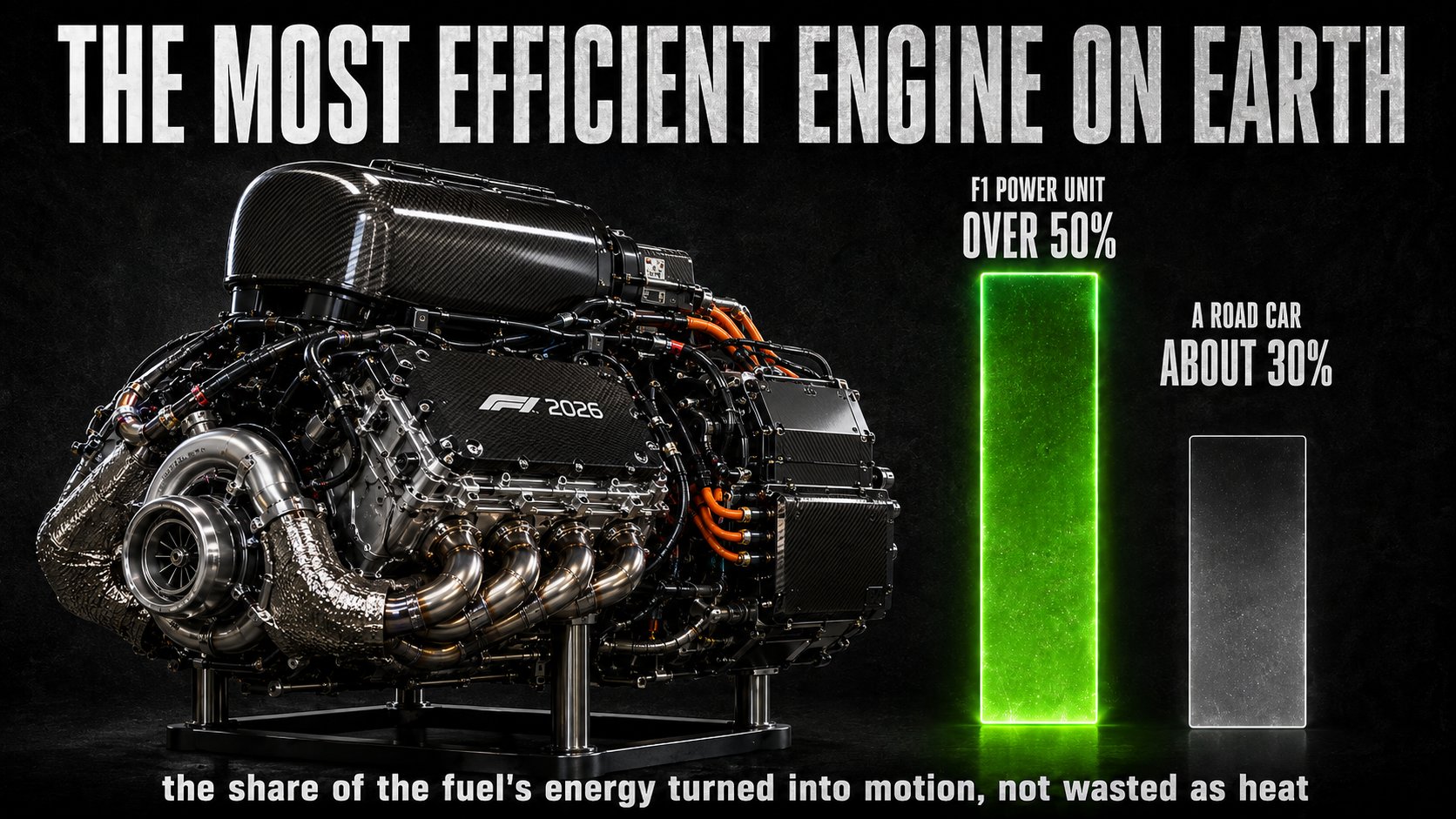
Image source: Formula Dream.
Yet the basic principles are surprisingly approachable.
A Formula 1 car produces power by combining a turbocharged internal combustion engine with an electrical system that recovers, stores, and redeploys energy.
The challenge is making these systems work together efficiently while maintaining reliability and complying with strict technical regulations.
Understanding how Formula 1 engines work also reveals why modern racing is not simply a competition to build the most powerful engine. Efficiency, cooling, weight, software, and energy management can be equally important.
What Is a Formula 1 Power Unit?
In everyday conversation, people often refer to the machinery powering an F1 car as its engine.
However, the more accurate term is power unit.
The distinction matters because a modern Formula 1 car does not rely exclusively on an internal combustion engine.
Its power unit combines several systems that work together to generate and manage power.
The main components of a 2026 Formula 1 power unit include:
- A 1.6-liter turbocharged V6 internal combustion engine.
- A turbocharger that compresses incoming air.
- An MGU-K electric motor-generator.
- An energy store that holds recovered electrical energy.
- Control electronics that coordinate the hybrid system.
Each component performs a different task, but the overall objective is straightforward: produce strong performance while using the available energy as effectively as possible.
Why Do Formula 1 Cars Use V6 Engines?
Modern Formula 1 cars use 1.6-liter V6 engines rather than the large naturally aspirated engines associated with earlier racing eras.
The V6 configuration has six cylinders arranged in two banks.
Inside each cylinder, a piston moves up and down as the engine completes its combustion cycle.
Air enters the cylinder, fuel is injected, and the mixture is ignited.
The resulting combustion produces pressure that pushes the piston downward.
That movement turns the crankshaft, converting combustion energy into mechanical power.
Although the displacement is relatively small, turbocharging and advanced engineering allow the engine to produce extraordinary performance.
The V6 configuration also provides a compact foundation for integrating the electrical components of the hybrid system.
How Does a Turbocharger Work in Formula 1?
A turbocharger increases the amount of air entering the engine.
It does this by using energy from exhaust gases.
When combustion gases leave the engine, they pass through a turbine.
The turbine is connected to a compressor that pressurizes incoming air.
Compressed air allows more oxygen to enter the cylinders, supporting greater power output from a relatively small engine.
Without turbocharging, producing comparable power from a 1.6-liter engine would be far more difficult.
However, turbocharging introduces additional engineering challenges.
Compressing air raises its temperature, so cooling becomes important.
The turbocharger also operates at extremely high rotational speeds and must withstand intense heat.
Engineers therefore need to optimize airflow, thermal management, durability, and throttle response.
What Is the MGU-K in Formula 1?
One of the most important components of a modern Formula 1 hybrid system is the Motor Generator Unit–Kinetic, commonly called the MGU-K.
The MGU-K performs two major functions.
First, it can recover energy when the car slows down.
Second, it can use stored electrical energy to provide additional mechanical power.
When the driver brakes, the MGU-K can operate as a generator.
Instead of allowing all the vehicle’s kinetic energy to disappear as heat through the braking system, part of that energy is converted into electricity.
The recovered electricity can then be stored in the energy store.
When additional power is needed, the system operates as a motor and contributes torque to the drivetrain.
This process is central to the efficiency of modern Formula 1.
How Does Energy Recovery Work?
Energy recovery is one of the defining features of hybrid Formula 1 technology.
Imagine a driver approaching a slow corner at high speed.
The driver presses the brake pedal, and the car begins to decelerate.
In a conventional braking system, much of the kinetic energy removed from the vehicle becomes heat.
In a hybrid Formula 1 car, the MGU-K can recover part of that energy and convert it into electricity.
The energy is transferred to the battery system, where it can be stored temporarily.
Later, when the driver accelerates, the electrical system can return energy to the drivetrain.
The process does not create free energy.
There are losses during recovery, storage, and deployment.
Nevertheless, it allows the car to reuse energy that would otherwise be wasted.
What Is the Energy Store?
The energy store is the high-performance battery system used by the hybrid power unit.
Its role is to hold electrical energy recovered by the MGU-K and make that energy available when required.
Unlike the battery in an ordinary road car, the Formula 1 energy store is designed for demanding cycles of rapid charging and discharging.
During a race, the system may repeatedly receive energy under braking and release energy during acceleration.
Engineers must carefully manage battery temperature, electrical limits, reliability, and available energy.
The energy store is therefore not simply a container for electricity.
It is part of a tightly controlled system that influences the car’s performance throughout every lap.
How Do the Combustion Engine and Electric Motor Work Together?
The internal combustion engine and MGU-K contribute power through the drivetrain.
However, they do not necessarily deliver their maximum output at every moment.
Power delivery depends on the driver’s demand, the car’s operating conditions, and the available electrical energy.
When the driver accelerates out of a corner, the combustion engine provides mechanical power while the MGU-K may add electrical assistance.
On a long straight, the control system must decide how much energy to deploy and how much to preserve for later sections of the lap.
Under braking, the MGU-K can recover energy again.
The entire process is coordinated through sophisticated control electronics.
This is why the performance of a Formula 1 power unit cannot be judged only by its peak horsepower.
How effectively it delivers power across a complete lap is just as important.
What Changed in Formula 1 Power Units for 2026?
The 2026 regulations introduced one of the most significant changes to Formula 1 power-unit technology since the beginning of the turbo-hybrid era in 2014.
The fundamental architecture remains based on a 1.6-liter turbocharged V6 engine.
However, the balance between combustion power and electrical power has changed substantially.
The electrical system plays a much larger role in overall performance.
Under the 2026 technical framework, the MGU-K is permitted to deliver up to 350 kilowatts of electrical power, compared with 120 kilowatts under the previous regulations.
That is a substantial increase in the importance of electrical deployment.
Another major change is the removal of the MGU-H.
The revised regulations also require advanced sustainable fuel.
Together, these developments create a power unit with different engineering priorities from its predecessor.
What Was the MGU-H, and Why Was It Removed?
From 2014 through 2025, Formula 1 hybrid power units included a component called the Motor Generator Unit–Heat, or MGU-H.
Despite its name, the MGU-H was mechanically connected to the turbocharger shaft.
It could recover energy associated with the turbocharger’s operation and could also help control turbocharger speed.
This provided performance and efficiency advantages, including improved turbo response.
However, the technology was extremely complex and expensive to develop.
The 2026 regulations eliminated the MGU-H.
One objective of the change was to simplify the power-unit architecture and make the regulations more attractive to manufacturers.
Without the MGU-H, teams must manage turbocharger behavior and energy deployment differently.
This creates new challenges for engine response, electrical energy management, and overall performance.
How Powerful Are Modern Formula 1 Engines?
Modern Formula 1 power units are capable of producing extraordinary power from a relatively small combustion engine.
However, an exact horsepower figure is not universal.
Different manufacturers develop different engines, and total output varies with operating conditions, electrical deployment, and technical limitations.
For the 2026 regulations, the FIA’s published technical framework describes a combustion-engine contribution of approximately 400 kilowatts alongside an electrical system capable of delivering up to 350 kilowatts.
These values explain the intended shift toward a much greater electrical contribution.
They should not be interpreted as a guarantee that every car continuously produces the simple sum of those figures throughout a lap.
Actual performance depends on energy availability, deployment limits, operating conditions, and the manufacturer’s design.
Why Is Energy Management So Important?
A Formula 1 driver cannot assume that maximum electrical assistance will always be available.
The battery contains a limited amount of usable energy, and the system must operate within strict regulations.
That creates an important strategic challenge.
If too much energy is deployed early in a lap, less may remain available for later acceleration zones.
If the system conserves too much energy, the driver may lose time unnecessarily.
Teams therefore develop sophisticated strategies for when to recover, store, and deploy electricity.
Energy management becomes especially important when defending a position or attempting an overtake.
The fastest theoretical lap may require a different deployment strategy from the most effective approach during a close race.
How Does Formula 1’s 2026 Overtake Mode Work?
The 2026 technical regulations introduced an overtaking-related electrical energy deployment function.
It forms part of the broader shift away from the traditional Drag Reduction System used in earlier seasons.
Under the new framework, additional electrical energy deployment can help a following driver challenge the car ahead when the relevant conditions are met.
This does not mean a driver receives unlimited power.
The system remains subject to technical restrictions, energy availability, and sporting procedures.
It also operates alongside the car’s active aerodynamic systems.
For beginners, the important distinction is that the 2026 overtaking approach relies more heavily on controlled electrical deployment than the older rear-wing-opening DRS concept.
What Fuel Do Modern Formula 1 Cars Use?
Formula 1 fuel is highly specialized and must comply with strict technical regulations.
The 2026 regulations introduced advanced sustainable fuel requirements.
These fuels are designed to meet defined sustainability criteria while supporting the performance demands of high-efficiency racing engines.
The objective is to reduce dependence on newly extracted fossil carbon while maintaining the use of internal combustion technology.
However, sustainable fuel does not mean the engine produces no exhaust emissions.
Combustion still releases carbon dioxide and other emissions.
The environmental argument depends on factors such as feedstock, production processes, energy sources, and lifecycle accounting.
Formula 1’s fuel strategy is therefore part of a wider attempt to improve sustainability rather than a claim that combustion engines have become emission-free.
Why Do Formula 1 Engines Need Advanced Cooling?
High-performance power units generate substantial heat.
The combustion engine produces heat through fuel combustion and mechanical friction.
The turbocharger operates in an extremely demanding thermal environment.
The electrical system, battery, and control electronics also require temperature management.
If temperatures become excessive, performance may need to be reduced to protect components.
Teams therefore design sophisticated cooling systems involving radiators, heat exchangers, fluid circuits, and carefully controlled airflow.
Cooling creates an aerodynamic tradeoff.
Larger cooling openings can improve heat rejection but may increase drag or reduce aerodynamic efficiency.
Smaller openings may improve airflow around the car while increasing the risk of overheating.
Finding the right balance is an important part of Formula 1 car design.
Why Does Engine Reliability Matter So Much?
A Formula 1 power unit must deliver exceptional performance while surviving demanding racing conditions.
Drivers regularly operate at high engine speeds, accelerate aggressively, and experience intense mechanical loads.
The power unit must also cope with changes in temperature, vibration, and energy demand.
Reliability matters because a mechanical failure can immediately end a race.
Teams also face restrictions on the number of certain power-unit components they can use during a championship season.
Exceeding the permitted allocation can result in grid penalties under the applicable sporting regulations.
Manufacturers therefore cannot focus entirely on peak output.
They must balance power, durability, efficiency, and long-term performance.
How Do Engineers Monitor Formula 1 Power Units?
Modern Formula 1 cars use extensive sensor and telemetry systems.
These systems provide information about temperatures, pressures, electrical behavior, engine operation, and other performance parameters.
Engineers analyze this information to understand how the power unit is performing.
During practice, teams can compare different operating settings and evaluate the consequences.
During races, engineers monitor reliability risks and help manage energy usage.
Software is especially important because the hybrid power unit must coordinate several systems at once.
The driver controls the car, but the underlying electronics manage many complex processes within the regulatory framework.
This combination of mechanical engineering and software control is one of the defining characteristics of modern Formula 1 technology.
How Are Formula 1 Engines Different From Road-Car Engines?
Formula 1 engines and ordinary road-car engines share fundamental combustion principles.
Both can use pistons, crankshafts, fuel injection, turbocharging, and electronic management.
However, their priorities are very different.
A road-car engine must operate reliably across many years of everyday use.
It must also satisfy requirements involving cost, comfort, noise, emissions, and maintenance.
A Formula 1 power unit is developed for a highly specialized competition environment.
Engineers prioritize performance, energy efficiency, packaging, weight, and reliability within a demanding racing schedule.
The materials, manufacturing tolerances, control strategies, and operating conditions can be substantially more specialized.
Although some engineering knowledge can transfer between motorsport and road vehicles, a Formula 1 power unit is not simply a road-car engine with extra horsepower.
How Have Formula 1 Engines Changed Over Time?
The history of Formula 1 engines reflects changing regulations and engineering priorities.
The Early Championship Years
During the 1950s, Formula 1 used a variety of engine configurations, including supercharged and naturally aspirated designs.
Mechanical simplicity and raw performance were important, but reliability was often a major limitation.
The V8 and V12 Eras
Later decades featured iconic naturally aspirated engines, including V8 and V12 configurations.
These engines became closely associated with the sound and character of classic Formula 1.
The Turbo Era
Turbocharged engines became especially prominent during the 1980s.
They delivered extraordinary power but introduced challenges involving fuel consumption, heat, and turbo response.
The Naturally Aspirated V10 and V8 Years
Formula 1 later became famous for high-revving naturally aspirated engines.
V10 engines defined much of the late 1990s and early 2000s, while 2.4-liter V8 engines were used from 2006 through 2013.
The Turbo-Hybrid Era From 2014
The introduction of 1.6-liter turbocharged V6 hybrid power units in 2014 fundamentally changed the sport’s engineering priorities.
Energy recovery and electrical deployment became central to performance.
The 2026 Power-Unit Generation
The 2026 regulations retain the turbocharged V6 concept but significantly increase the importance of electrical power.
The removal of the MGU-H and the introduction of advanced sustainable fuel requirements mark another important technical transition.
What Are the Biggest Challenges for Formula 1 Engine Manufacturers?
Developing a competitive power unit requires manufacturers to solve several problems simultaneously.
They need strong combustion efficiency without sacrificing reliability.
They must optimize electrical energy recovery and deployment while controlling weight and temperature.
Turbocharger response must be carefully managed, particularly without the MGU-H.
Cooling systems must protect components without creating excessive aerodynamic drag.
Software must coordinate the entire system while complying with technical regulations.
Manufacturers also need to integrate the power unit with the chassis.
A powerful engine can become less effective if its size, cooling requirements, or installation compromise the car’s aerodynamics.
For that reason, the most successful Formula 1 power unit is not necessarily the one with the highest isolated output.
It is the one that contributes most effectively to the performance of the complete racing car.
Frequently Asked Questions About Formula 1 Engines
What engine does Formula 1 use in 2026?
Formula 1 uses 1.6-liter turbocharged V6 hybrid power units under the 2026 technical regulations.
Are Formula 1 cars fully electric?
No. Modern Formula 1 cars combine internal combustion engines with electrical energy recovery and deployment systems.
What does MGU-K stand for?
MGU-K stands for Motor Generator Unit–Kinetic. It recovers kinetic energy and can provide electrical power to the drivetrain.
What happened to the MGU-H?
The MGU-H was removed from the Formula 1 power-unit regulations beginning in 2026.
How much electrical power can a 2026 F1 car deploy?
The 2026 power-unit regulations permit an MGU-K maximum power of 350 kilowatts, subject to the relevant technical and energy-management restrictions.
Do Formula 1 cars use batteries?
Yes. Hybrid Formula 1 cars use an energy store to hold recovered electrical energy for later deployment.
Why do Formula 1 cars recover energy when braking?
Energy recovery allows part of the car’s kinetic energy to be converted into electricity instead of being lost entirely as heat.
Do Formula 1 cars use sustainable fuel?
The 2026 regulations introduced advanced sustainable fuel requirements as part of the championship’s evolving technical framework.
Are Formula 1 engines the same as road-car engines?
No. Although they share fundamental engineering principles, Formula 1 power units are specialized systems designed for extreme racing performance and strict technical regulations.
Conclusion: Formula 1 Power Units Are About More Than Horsepower
The most impressive feature of a modern Formula 1 power unit is not simply how much power it produces, but how intelligently it uses energy.
The internal combustion engine provides the foundation, while the turbocharger improves its ability to generate power from a relatively small displacement.
The MGU-K recovers energy during braking and contributes electrical assistance when needed.
The energy store holds that electricity, and sophisticated control systems coordinate the entire process.
With the 2026 regulations placing greater emphasis on electrical deployment, energy management has become even more important.
Manufacturers must now balance combustion performance, electrical efficiency, cooling, reliability, and chassis integration within a demanding technical framework.
For fans, understanding these systems reveals a different side of Formula 1.
Every acceleration zone, braking point, and overtaking attempt involves more than a driver’s right foot.
Behind the action is a complex engineering system designed to extract the greatest possible performance from every available unit of energy.
That is what makes modern Formula 1 power units such a remarkable achievement in motorsport technology.
Leave a Reply