Formula 1 Tire Compounds Explained: Soft, Medium, and Hard
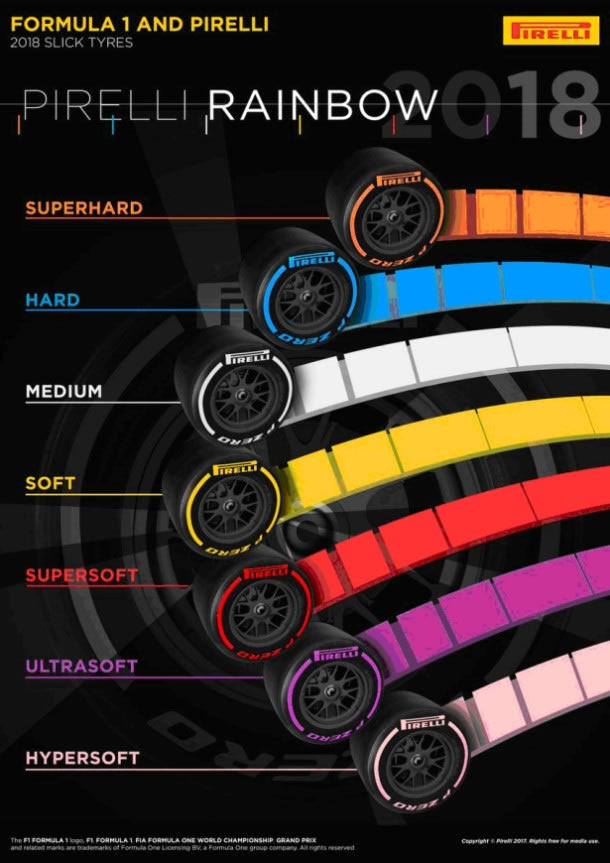
One of the most visible aspects of Formula 1 tire strategy is the choice between three dry-weather compounds: Soft, Medium, and Hard.
Each compound offers a different balance between grip, durability, and operating characteristics.
The Soft tire generally provides the greatest immediate grip but tends to wear more quickly. The Hard tire is designed to tolerate greater demands over longer periods, while the Medium offers a compromise between the two.
However, the fastest tire on paper is not necessarily the best choice for every race situation.
Understanding Formula 1 tire compounds reveals why pit stops, temperature management, and strategic decisions can be just as important as overtaking on the circuit.
What Are Formula 1 Tire Compounds?
A tire compound refers to the mixture of materials used to create the tire’s rubber tread.
Formula 1 tire compounds are engineered to provide particular performance characteristics under extreme racing conditions.
They must cope with high cornering forces, heavy braking, rapid acceleration, and significant temperature changes.
Different compounds respond differently to these demands.
A softer compound is generally designed to deliver greater mechanical grip, especially when it reaches its intended operating temperature.
A harder compound is generally more resistant to wear and may provide a more stable option over a longer stint.
But tire performance is not determined by hardness alone.
Construction, track surface, temperature, car setup, fuel load, and driver behavior all influence how a tire performs.
Modern Formula 1 uses Pirelli as its exclusive tire supplier, meaning all teams compete with tires supplied by the same manufacturer.
Although the tires are standardized in that sense, teams can achieve very different results depending on how effectively their cars use them.
Understanding the Three Main Dry-Weather Tire Compounds
During a typical dry Formula 1 weekend, Pirelli nominates three compounds from its available slick-tire range.
These are identified to spectators using three colors.
- Soft — Red: Usually the highest-grip option of the three nominated compounds.
- Medium — Yellow: A balance between grip and durability.
- Hard — White: Usually the most durable of the three nominated compounds.
The colors help viewers identify the tires quickly, but they do not always represent exactly the same underlying rubber compound from one race to another.
For example, a tire designated as the Soft at one Grand Prix might be designated as the Medium at another, depending on which compounds Pirelli selects.
This is an important distinction because tire performance must always be considered in the context of the compounds available for a particular event.
Soft Tires: Maximum Grip and Shorter Stints
Soft tires are marked with red sidewall lettering.
They are generally the quickest of the three nominated dry-weather compounds when conditions allow them to operate effectively.
Their greater grip can help drivers accelerate out of corners, brake later, and maintain higher cornering speeds.
This makes Soft tires especially attractive during qualifying, when drivers attempt to produce the fastest possible single lap.
However, the additional grip usually comes with a trade-off.
Soft tires often experience greater wear and thermal degradation than harder alternatives.
As the tire surface and internal structure are subjected to repeated loads, performance can begin to decline.
When Are Soft Tires Most Useful?
Soft tires can be valuable in several situations.
- Qualifying sessions where maximum lap time performance is the priority.
- Short race stints when tire durability is less important.
- Late-race attacks when a driver needs immediate pace.
- Cooler conditions where a softer compound may reach its working temperature more easily.
- Situations where rapid acceleration and strong mechanical grip are particularly valuable.
Nevertheless, Soft tires are not automatically the fastest choice in every circumstance.
On a very hot or abrasive circuit, they may overheat or degrade rapidly.
A driver who pushes too aggressively can lose the initial advantage after only a limited number of laps.
The key is using their performance without exhausting their available grip too quickly.
Medium Tires: The Balance Between Speed and Durability
Medium tires are identified by yellow sidewall markings.
They occupy the middle position among the three compounds nominated for a race weekend.
In many circumstances, they provide a useful balance between immediate performance and the ability to maintain competitive lap times over a longer stint.
This flexibility makes them an important strategic option.
Medium tires may allow a driver to remain on track longer than a competitor using Soft tires while still maintaining enough grip to defend or attack.
They can also provide a more manageable operating window under conditions where the Soft compound experiences excessive degradation.
Why Teams Often Choose Medium Tires
Teams may favor Medium tires because they offer flexibility.
A driver starting on Medium tires may be able to extend the first stint and respond to changes in race circumstances.
If a safety car appears, the team may have more strategic options depending on the tire’s remaining condition.
Medium tires can also be useful when teams are uncertain about how quickly the track surface will evolve.
However, the Medium is not necessarily the ideal compound at every circuit.
Some tracks place such high demands on tires that the Hard compound becomes more effective for longer runs.
Other circuits may produce very low degradation, allowing Soft tires to remain competitive for longer than expected.
That is why teams rely on practice data rather than assumptions based solely on compound names.
Hard Tires: Durability and Long-Race Strategy
Hard tires feature white sidewall markings.
They are generally the most durable of the three compounds selected for a Grand Prix.
Their construction and rubber characteristics are intended to cope with demanding conditions over longer periods.
Hard tires may be particularly valuable at circuits where high-speed corners, abrasive asphalt, and sustained loads place significant stress on the rubber.
However, the greater durability usually comes with a disadvantage.
Hard tires may provide less immediate grip than softer alternatives and can be more difficult to bring into their ideal operating temperature range.
This can create challenges after a pit stop.
A driver leaving the pit lane on cold Hard tires may struggle initially against a competitor whose tires are already operating effectively.
When Are Hard Tires the Better Choice?
Hard tires can become particularly effective when:
- A team wants to complete a long race stint.
- The circuit produces significant tire degradation.
- Track temperatures are high.
- A one-stop strategy is being considered.
- Maintaining consistent lap times matters more than maximum short-term pace.
Hard tires are not always slower over an entire race stint.
Although they may begin with less grip, their performance can remain more stable while softer tires lose pace through degradation.
Over many laps, this difference can change which compound produces the better overall race time.
Soft vs. Medium vs. Hard: F1 Tire Compound Comparison
The following table summarizes the general characteristics of the three nominated dry-weather tire compounds.
| Feature | Soft | Medium | Hard |
|---|---|---|---|
| Sidewall Color | Red | Yellow | White |
| Typical Initial Grip | Highest | Balanced | Lowest |
| Typical Durability | Lowest | Moderate | Highest |
| Common Use | Qualifying and short stints | Flexible race strategies | Longer race stints |
| Typical Limitation | Faster degradation | Compromise in performance | Slower warm-up and less initial grip |
These descriptions are general tendencies rather than fixed guarantees.
The actual differences depend on the specific compounds nominated, the circuit, weather, and how each car uses its tires.
Why the Soft Tire Is Not Always the Fastest Choice
It may seem logical that a driver should always choose the tire offering the most grip.
But Formula 1 races are not decided by one lap.
A race consists of many laps, and the performance of a tire changes throughout a stint.
Consider a simplified example.
A driver using Soft tires might initially be several tenths of a second faster per lap than a competitor using Hard tires.
However, if the Soft tires degrade rapidly, that advantage can disappear.
The Hard tires may then provide more consistent performance over a longer distance.
In addition, choosing Soft tires may require an extra pit stop.
Because pit stops cost time, a strategy that produces faster individual laps does not necessarily produce the fastest total race time.
Teams must therefore evaluate the relationship between lap time, tire life, and pit-stop losses.
What Is Tire Degradation in Formula 1?
Tire degradation describes the reduction in performance that occurs as a tire is used.
It can result from several factors, including mechanical wear, excessive temperature, and changes in the rubber’s behavior.
As a tire degrades, the driver may experience reduced grip, longer braking distances, and difficulty maintaining cornering speed.
However, degradation does not always happen at a constant rate.
A tire may perform consistently for several laps before its pace begins to decline more rapidly.
Alternatively, a driver may experience temporary performance loss from overheating that improves once temperatures return to a more suitable range.
Thermal Degradation
Thermal degradation occurs when the tire is exposed to temperatures that negatively affect its performance.
Excessive heat can change the rubber’s characteristics and reduce available grip.
Drivers may respond by reducing their pace, adjusting their driving style, or avoiding unnecessary sliding.
Mechanical Wear
Mechanical wear involves the physical removal or deterioration of tread material through contact with the track.
Abrasive surfaces and aggressive driving can increase wear.
Over time, the tire may lose performance as its condition deteriorates.
Graining
Graining occurs when rubber on the tire surface is stressed and forms small irregular deposits or ridges.
This can reduce the effective contact between the tire and the track.
Graining may be associated with sliding and unfavorable operating conditions.
In some cases, the tire’s performance can improve after the grained surface wears away.
Blistering
Blistering occurs when excessive heat contributes to localized damage within the tire’s tread.
This can cause sections of rubber to separate or break away, reducing performance and potentially creating durability concerns.
Teams monitor temperatures and tire condition carefully to reduce the risk of such problems.
Why Tire Temperature Matters So Much
Formula 1 tires are designed to operate within particular temperature ranges.
If a tire is too cold, the rubber may not provide its intended level of grip.
If it becomes too hot, performance can also decline.
The ideal operating range depends on the compound, construction, and conditions.
Drivers and engineers therefore aim to maintain temperatures that provide strong grip without creating excessive degradation.
Braking, acceleration, and cornering all generate energy that affects tire temperature.
Car setup also influences how loads are distributed across the tires.
For example, a car that slides excessively through corners may generate unnecessary heat and wear.
A more balanced car may preserve its tires while maintaining competitive lap times.
This is one reason why two drivers using the same compound can experience very different levels of degradation.
How Track Conditions Influence Tire Choice
Every Formula 1 circuit presents different challenges.
Some tracks feature long, high-speed corners that place sustained loads on the tires.
Others contain heavy braking zones and slow corners where traction becomes particularly important.
The track surface also matters.
Rough or abrasive asphalt can increase mechanical wear.
Smoother surfaces may reduce wear but create different challenges when tires struggle to reach their operating temperature.
Ambient temperature, track temperature, and weather conditions can also influence compound selection.
At a hot circuit, a softer tire may overheat quickly.
At a cooler circuit, a harder tire may struggle to generate sufficient temperature.
Teams must consider all of these factors when choosing their race strategy.
How Pirelli Selects Tires for Each Grand Prix
Pirelli does not necessarily bring the same three underlying slick compounds to every Formula 1 race.
Instead, it selects three compounds from its available range according to the characteristics of the circuit and expected conditions.
The softest of those nominated compounds receives red markings.
The middle option receives yellow markings, and the hardest receives white markings.
This means that the compound labeled Soft at one circuit can differ from the compound labeled Soft at another.
For example, if Pirelli selects three relatively hard compounds for a demanding circuit, the tire marked Soft may be harder than a tire marked Medium at another event.
Understanding this system helps explain why tire behavior can differ significantly between Grands Prix.
The visible colors indicate the relative choices available for that weekend, not a universal level of hardness across the entire championship.
Why Formula 1 Teams Use Different Tire Strategies
Formula 1 teams do not always agree on the best tire strategy.
Some may prioritize track position, while others attempt to gain an advantage through longer stints or fresher tires late in the race.
The decision depends on several variables.
- Expected tire degradation.
- Time lost during a pit stop.
- Track position and traffic.
- Weather conditions.
- Safety car probability.
- Available tire sets.
- The car’s strengths and weaknesses.
These factors can create different strategic approaches even among drivers competing in similar positions.
One-Stop Strategy
A one-stop strategy involves changing tires once during the race.
It may be effective when degradation is relatively low or when the time lost during a pit stop is significant.
However, the driver must manage tire wear carefully to complete longer stints.
Two-Stop Strategy
A two-stop strategy involves changing tires twice.
It may allow drivers to use faster compounds or push harder during shorter stints.
But the additional pit stop costs time.
The strategy only works if the extra pace gained from fresher tires is sufficient to compensate for that loss.
Undercut Strategy
An undercut occurs when a driver pits earlier than a nearby competitor in an attempt to gain time on fresher tires.
If the new tires provide a significant performance advantage, the driver may move ahead when the rival eventually stops.
However, the undercut is less effective when tire warm-up is slow or when the driver rejoins the race in traffic.
Overcut Strategy
An overcut involves staying on track longer than a competitor who has already stopped.
It can work when the existing tires remain competitive or when the rival struggles to warm up fresh tires.
Clean air and track position may also contribute to a successful overcut.
Why Pit Stops Can Decide a Formula 1 Race
A Formula 1 pit stop is not simply a moment when mechanics replace tires.
It is a strategic decision that affects the driver’s position and the remaining race.
Stopping too early may leave a driver struggling with worn tires near the finish.
Stopping too late may sacrifice valuable time behind slower competitors.
Teams use simulation models and live data to estimate the best time to change tires.
However, unexpected events can disrupt even the most carefully prepared strategy.
A safety car may reduce the relative time lost during a pit stop.
Sudden rain may force drivers to switch from slick tires to wet-weather compounds.
Traffic can also prevent a driver from taking full advantage of fresh tires.
Successful strategy therefore requires both preparation and the ability to adapt quickly.
Do Formula 1 Drivers Have to Use Different Tire Compounds?
Under the standard dry-race rules, drivers must use at least two different specifications of dry-weather tires during a Grand Prix.
This generally requires at least one tire change.
However, the requirement does not apply in the same way when intermediate or wet-weather tires are used during the race.
Special event regulations can also create additional requirements, so teams must follow the rules applicable to each Grand Prix.
The two-compound requirement adds a strategic element because teams cannot simply select one dry compound and use it for the entire race under normal conditions.
They must decide which combination provides the best balance of pace and durability.
What About Intermediate and Wet Tires?
Soft, Medium, and Hard are the three categories used to identify the nominated dry-weather slick tires.
Formula 1 also uses specialized tires for wet conditions.
Intermediate Tires — Green
Intermediate tires feature green sidewall markings.
They are designed for damp or wet circuits where water is present but conditions may not require the most aggressive water-clearing tread.
Unlike slick tires, intermediates have grooves that help displace water.
They can be useful when a circuit is drying or when rain is relatively light.
Full Wet Tires — Blue
Full Wet tires feature blue sidewall markings.
They are designed to disperse larger amounts of water and reduce the risk of aquaplaning.
However, heavy rain can still create dangerous visibility and grip conditions.
The availability of Full Wet tires does not guarantee that racing can continue safely in every weather situation.
How Drivers Make Tires Last Longer
Tire management is one of the most important skills in Formula 1.
Drivers must balance speed against the risk of excessive wear or overheating.
A driver who pushes aggressively through every corner may produce fast initial lap times but damage the tires more quickly.
A driver who maintains smoother inputs may preserve grip for longer.
Several techniques can help manage tire performance.
- Reducing unnecessary wheelspin during acceleration.
- Avoiding excessive sliding through corners.
- Managing braking loads carefully.
- Adjusting pace when tire temperatures become excessive.
- Following team instructions based on live performance data.
These techniques do not mean driving slowly throughout a race.
Effective tire management involves choosing where to push and where to preserve performance.
The objective is to achieve the best possible result across the entire stint rather than one exceptionally fast lap.
Why Tire Strategy Is Part of Formula 1’s Competitive Identity
Formula 1 is often described as a competition between drivers and engineers.
Tire strategy demonstrates how closely those two roles are connected.
Engineers analyze data to estimate degradation, temperatures, and the ideal timing of pit stops.
Drivers must translate that information into consistent performance on the circuit.
Strategists must also react to competitors, traffic, and changing conditions.
The fastest car does not always win when tire management and race execution differ significantly.
A driver with slightly less outright pace may achieve a better result by extending a stint, avoiding traffic, or preserving tire performance.
This uncertainty is part of what makes Formula 1 strategically interesting.
Frequently Asked Questions About Formula 1 Tire Compounds
What are the three main Formula 1 tire compounds?
The three dry-weather tire categories nominated for a Grand Prix are Soft, Medium, and Hard.
What color are Soft tires in Formula 1?
Soft tires have red sidewall markings.
What color are Medium tires in Formula 1?
Medium tires have yellow sidewall markings.
What color are Hard tires in Formula 1?
Hard tires have white sidewall markings.
Which Formula 1 tire is the fastest?
The Soft compound generally provides the highest immediate grip among the three nominated dry-weather tires, but actual performance depends on temperature, circuit conditions, and degradation.
Which Formula 1 tire lasts the longest?
The Hard compound is generally designed to offer the greatest durability among the three nominated dry-weather tires.
Why do Soft tires wear out faster?
Soft tires typically prioritize grip over durability, making them more vulnerable to wear and thermal degradation under demanding conditions.
Can Hard tires be faster than Soft tires?
Yes. Over a long stint, Hard tires may become more competitive if Soft tires lose performance through degradation.
Why do Formula 1 teams use different compounds?
Different compounds allow teams to balance grip, tire life, track position, and pit-stop strategy.
Do F1 drivers have to change tires during a race?
Under normal dry-race regulations, drivers must use at least two different dry-weather tire specifications, generally requiring a pit stop. Wet-weather conditions and special event rules can change the requirements.
What is tire degradation?
Tire degradation is the loss of performance caused by factors such as wear, temperature, and changes in the rubber’s condition.
What is the difference between intermediate and wet tires?
Intermediate tires are designed for damp or moderately wet conditions, while Full Wet tires are designed to displace larger amounts of water.
Are Soft tires the same at every Grand Prix?
No. Pirelli selects three compounds for each event, and the softest of those nominated compounds receives the red Soft designation.
Conclusion: Why Formula 1 Tire Choice Matters
Formula 1 tire compounds are a fundamental part of modern racing strategy.
Soft tires generally provide greater immediate grip, Medium tires offer a compromise between performance and durability, and Hard tires are designed to handle longer or more demanding stints.
However, their effectiveness depends on much more than the compound name.
Track temperature, asphalt characteristics, car setup, driving style, and race circumstances all influence how tires behave.
Teams must constantly evaluate whether the additional speed of a softer compound is worth the potential increase in degradation or the need for another pit stop.
Drivers must also manage their tires carefully, maintaining enough pace to remain competitive without using up their performance too early.
The result is a strategic contest in which the fastest individual lap does not always lead to victory.
Understanding Soft, Medium, and Hard tires helps explain one of Formula 1’s most important lessons: winning a Grand Prix is not only about driving quickly, but about knowing when and how to use the performance available.
Leave a Reply