MotoGP Sprint Races Explained: Format, Points, and Strategy
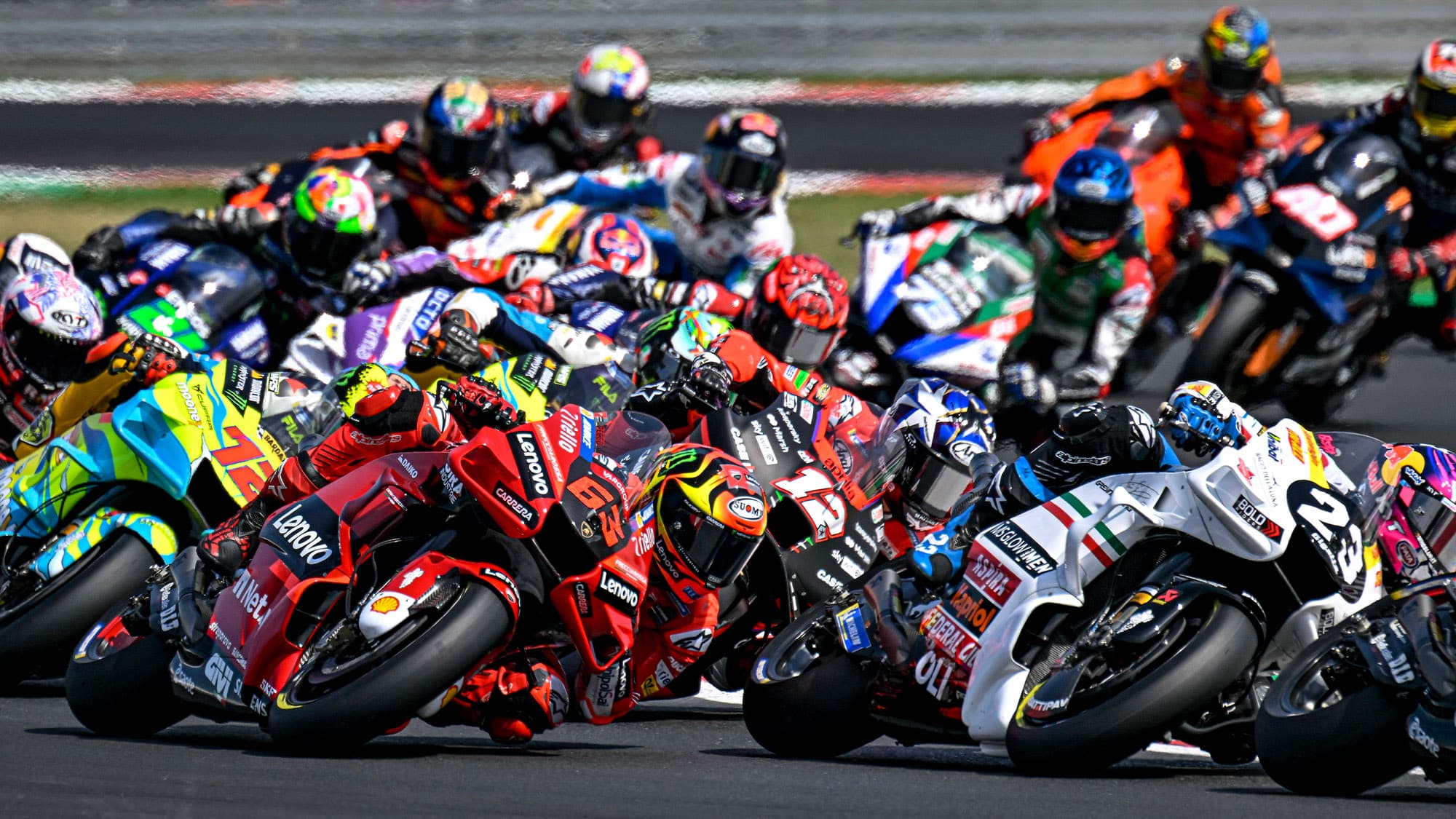
Now, riders compete for championship points on Saturday before returning to the circuit for the full-distance Grand Prix on Sunday. The Sprint is shorter, but it carries real consequences for the championship.
A rider can gain valuable points, lose ground to a rival, or suffer a crash that complicates the remainder of the weekend.
For teams, the format introduces another competitive challenge. Engineers have less time to prepare, riders must adapt quickly, and race strategy becomes more complicated.
But what exactly is a MotoGP Sprint race? How are points awarded, why is the distance shorter, and what makes its strategy different from a traditional Grand Prix?
Understanding the Sprint format helps explain why Saturday has become such an important part of modern MotoGP.
What Is a MotoGP Sprint Race?
A MotoGP Sprint is a short-distance race held on Saturday during a Grand Prix weekend.
It is contested by riders in the premier MotoGP class and awards championship points to the first nine finishers.
Unlike a practice session or exhibition event, the Sprint is an official competitive race with a direct effect on the riders’ and teams’ championship campaigns.
The Sprint does not replace Sunday’s Grand Prix.
Instead, it creates a second opportunity for riders to score points during the same weekend.
Both races contribute to the championship, but they differ in distance, points allocation, and strategic demands.
The Sprint is designed to be approximately half the distance of the Sunday Grand Prix.
This shorter format encourages a different approach to racing, particularly when it comes to tire management, overtaking, and risk.
When Were Sprint Races Introduced in MotoGP?
MotoGP introduced Sprint races at the beginning of the 2023 season.
The change represented one of the most significant adjustments to the championship’s weekend structure in years.
Before 2023, riders generally competed in one championship race per Grand Prix weekend.
The introduction of Saturday Sprints created additional competitive action while retaining the traditional Sunday race.
Organizers intended the format to provide fans with more meaningful racing throughout the weekend.
For riders and teams, however, the change also increased the demands of competing across three days.
Saturday became more than a qualifying day. It became a race day in its own right.
How Does a MotoGP Sprint Weekend Work?
The modern MotoGP weekend follows a structure that combines practice, qualifying, the Sprint, and the main Grand Prix.
Although schedules can change because of weather or other operational circumstances, the standard format follows a recognizable pattern.
Friday: Practice and Preparation
Friday is primarily devoted to practice.
Riders work with their teams to understand track conditions, evaluate tire performance, and refine motorcycle settings.
The timed Practice session is particularly important because its results determine which riders qualify directly for Qualifying 2.
The ten fastest riders advance directly to Q2, while the remaining riders must participate in Q1.
Friday performance therefore influences the qualifying opportunities available on Saturday.
Saturday: Qualifying and Sprint Race
Saturday begins with a short practice session before qualifying.
Qualifying is divided into Q1 and Q2.
The two fastest riders in Q1 advance to Q2, where they join the ten riders who qualified directly from Friday’s Practice session.
Q2 determines the first twelve grid positions.
The qualifying results establish the starting grid for both the Saturday Sprint and Sunday’s Grand Prix.
Later on Saturday, riders compete in the Sprint race.
This creates an unusual situation: riders must push for maximum qualifying performance and then prepare for a competitive race on the same day.
Sunday: The Main Grand Prix
Sunday remains the centerpiece of the weekend.
Riders compete over the full Grand Prix distance, with more championship points available than in the Sprint.
The longer race introduces additional challenges involving tire wear, fuel consumption, and maintaining performance across a greater number of laps.
A strong Sprint result can provide momentum, but it does not guarantee success on Sunday.
How Long Is a MotoGP Sprint Race?
A MotoGP Sprint covers approximately half the distance of the corresponding Sunday Grand Prix.
The exact number of laps depends on the circuit.
Because tracks have different lengths, MotoGP determines the Sprint distance separately for each event.
For example, a Grand Prix scheduled for 24 laps may have a Sprint of approximately 12 laps.
However, the precise lap count should always be checked against the official schedule for that race weekend.
The shorter distance changes the demands placed on riders.
There is less time to recover from a poor start, fewer opportunities to gradually work through the field, and a smaller window in which to overtake competitors.
As a result, the opening laps often carry considerable importance.
MotoGP Sprint Race Points System Explained
Sprint races award championship points to the first nine riders who finish.
The winner receives 12 points, while ninth place earns one point.
Riders finishing tenth or lower do not score Sprint points.
| Finishing Position | Sprint Points |
|---|---|
| 1st | 12 |
| 2nd | 9 |
| 3rd | 7 |
| 4th | 6 |
| 5th | 5 |
| 6th | 4 |
| 7th | 3 |
| 8th | 2 |
| 9th | 1 |
| 10th or lower | 0 |
The system rewards strong performances while preserving the greater importance of Sunday’s race.
A Sprint victory is worth 12 points, compared with 25 points for winning the main Grand Prix.
However, those additional Saturday points can become extremely valuable during a close championship battle.
How Many Points Can a Rider Score in One MotoGP Weekend?
A rider who wins both the Sprint and Sunday’s Grand Prix can earn a maximum of 37 championship points in one weekend.
The calculation is straightforward:
Sprint victory: 12 points
Grand Prix victory: 25 points
Total: 37 points
This makes a perfect weekend particularly valuable.
A rider who consistently performs well in both races can build a significant championship advantage.
Conversely, a rider who struggles in Sprints may lose ground even when their Sunday results remain competitive.
Over a long season, these differences can accumulate.
MotoGP Sprint vs. Grand Prix: What Is the Difference?
Although both races award championship points, they place different demands on riders and teams.
| Feature | Sprint Race | Sunday Grand Prix |
|---|---|---|
| Race Day | Saturday | Sunday |
| Distance | Approximately half Grand Prix distance | Full scheduled race distance |
| Winner’s Points | 12 | 25 |
| Points-Scoring Positions | Top 9 | Top 15 |
| Starting Grid | Saturday qualifying results | Saturday qualifying results |
| Tire Management | Shorter-term performance | Greater emphasis on sustained performance |
| Race Strategy | Track position and immediate pace | Longer-term pace, tire wear, and race management |
These differences explain why the same rider can perform well in one race and struggle in the other.
A motorcycle setup that delivers excellent performance over a short distance may not necessarily be ideal for a full Grand Prix.
Why Qualifying Is So Important for Sprint Races
Qualifying has always mattered in MotoGP, but the Sprint format increases its significance.
Because the Sprint is relatively short, riders have less time to recover from a poor starting position.
A competitor starting near the front may be able to establish a strong position before the field settles into a rhythm.
A rider starting farther back must often make overtakes quickly to reach the points-scoring positions.
However, aggressive overtaking increases risk.
Attempting to gain several positions in a short period can lead to mistakes, contact, or excessive tire stress.
For this reason, qualifying performance can influence not only the Sprint result but also the amount of risk a rider must accept during the race.
It also affects Sunday’s Grand Prix because the same qualifying results determine the starting grid.
How Tire Strategy Works in a MotoGP Sprint
Tire strategy is one of the most important differences between Sprint races and full-distance Grands Prix.
In a longer race, riders must consider how tire performance changes over many laps.
Excessive early aggression can increase tire temperature and wear, reducing grip later in the race.
The shorter Sprint distance changes that calculation.
Riders may be able to use a more aggressive pace because the tires do not need to last as long.
However, this does not mean tire degradation becomes irrelevant.
A tire can still overheat or lose performance during a Sprint, particularly when a rider pushes hard while following another motorcycle.
Choosing the Right Tire Compound
MotoGP uses specialized Michelin racing tires under the current tire-supply arrangement.
Available compounds and their suitability vary according to the circuit and event conditions.
A softer compound may offer stronger initial grip but can become vulnerable to overheating or wear.
A harder option may provide greater stability over a longer distance, depending on track conditions.
Teams evaluate these compromises during practice.
The correct choice depends on factors such as asphalt temperature, track layout, riding style, and the motorcycle’s characteristics.
Why Tire Temperature Matters
Racing tires operate within specific temperature ranges.
If a tire is too cold, it may not provide sufficient grip.
If it becomes excessively hot, performance can deteriorate.
Sprint riders must bring their tires into an effective operating range quickly without causing unnecessary overheating.
That creates a delicate balance between immediate speed and maintaining grip until the finish.
Why Sprint Race Starts Are So Important
The opening moments of a MotoGP Sprint can strongly influence the final result.
With fewer laps available, losing several positions at the start can be particularly costly.
Riders must balance aggressive acceleration with control of the motorcycle.
Modern MotoGP machines produce enormous power, and race starts place significant demands on clutch control, traction, and weight transfer.
Launch and ride-height systems permitted under the applicable technical regulations can also influence how effectively a motorcycle accelerates from the grid.
However, a strong launch is only the beginning.
Riders must navigate the first braking zone, maintain their racing line, and avoid contact with nearby competitors.
Because the field is often tightly grouped during the opening corners, mistakes can have immediate consequences.
Why Overtaking Can Be More Aggressive in Sprint Races
Sprint races create urgency.
A rider who spends several laps waiting for an ideal overtaking opportunity may run out of time before reaching the desired position.
That pressure can encourage more aggressive racing.
Riders may attempt overtakes earlier, brake later, or accept smaller margins than they would during a longer race.
However, aggressive racing does not always produce better results.
A poorly timed maneuver can cost multiple positions or end the race entirely.
Successful Sprint riders must recognize when an overtaking opportunity is worth the risk.
They also need to understand the behavior of the motorcycles around them.
A rival may have stronger acceleration but weaker braking performance, creating opportunities at particular sections of the circuit.
These differences can determine where a rider chooses to attack.
The Risk of Crashing During a Sprint Race
One of the most controversial aspects of the Sprint format is the additional risk it introduces.
Riders now compete in two points-paying races during a typical Grand Prix weekend.
That means more competitive starts, more close battles, and additional opportunities for crashes.
A Sprint accident can have consequences beyond losing Saturday points.
A rider may suffer an injury, while the team may need to repair or rebuild the motorcycle before Sunday’s race.
Even a relatively minor incident can disrupt preparation.
Engineers may lose valuable time inspecting components, replacing damaged parts, or checking the motorcycle’s alignment.
For championship contenders, the decision to push aggressively for a few additional points must therefore be balanced against the possibility of compromising the main Grand Prix.
How Sprint Races Affect the MotoGP Championship
The Sprint format changes the mathematics of a championship season.
Before Sprint races were introduced, riders primarily accumulated race points through the Sunday Grand Prix.
Now, there is an additional opportunity to score points during each Sprint weekend.
This increases the importance of consistency.
A rider who frequently finishes near the front on Saturday can build a meaningful points advantage over a rival who performs well only on Sundays.
For example, consider two hypothetical championship contenders.
Rider A wins Sunday’s Grand Prix but finishes outside the Sprint points.
Rider B finishes second in the Sprint and second in the Grand Prix.
Rider A earns 25 points.
Rider B earns 9 points from the Sprint and 20 points from the Grand Prix, totaling 29.
Despite winning Sunday’s main race, Rider A loses four championship points to Rider B over the weekend.
This example demonstrates how Sprint consistency can influence the championship standings.
Can a Rider Win the Championship Without Winning Many Sprints?
Yes.
Sunday’s Grand Prix still awards substantially more points than the Sprint.
A rider who consistently performs strongly in full-distance races can remain a championship contender even without dominating Saturdays.
However, repeated poor Sprint results create additional pressure.
When rivals regularly collect Saturday points, the gap can become difficult to overcome.
Championship success therefore requires an effective balance between short-distance competitiveness and full-distance race performance.
The strongest riders are those who can adapt their approach without compromising consistency.
How Teams Prepare Differently for Sprint Races
The Sprint format has also changed the work of MotoGP engineers and mechanics.
With competitive racing scheduled on Saturday, teams have less time to experiment before the first points-paying event.
Friday practice becomes particularly valuable.
Engineers must gather information about tire behavior, braking performance, electronics, and motorcycle balance.
They also need to prepare settings that can perform effectively across two different race distances.
A Sprint-focused setup may emphasize immediate grip and acceleration.
A Grand Prix setup may require greater attention to tire durability and performance consistency.
However, teams cannot always make unlimited changes between sessions.
They must work within the applicable technical and sporting regulations.
The challenge is finding a competitive compromise while adapting to changing weather and track conditions.
How Sprint Results Influence Sunday’s Grand Prix
A Sprint provides useful information about race pace and motorcycle behavior.
Teams can observe how their tires perform under competitive conditions, where their riders gain or lose time, and how the motorcycle responds in traffic.
That information can help guide preparation for Sunday’s Grand Prix.
However, Sprint results do not determine the Sunday starting grid.
The grid is established by qualifying.
Winning Saturday’s Sprint therefore does not automatically give a rider pole position for Sunday.
Likewise, a rider who crashes in the Sprint does not automatically lose their original Sunday grid position, although penalties or other sporting circumstances may affect eligibility or starting arrangements.
This distinction is important because it separates the Sprint’s championship consequences from the qualifying procedure.
Are Sprint Races Better for MotoGP Fans?
From a spectator’s perspective, Sprint races offer an additional competitive event during the weekend.
Saturday now includes meaningful racing rather than serving primarily as preparation for Sunday.
The shorter distance can produce intense battles because riders have limited time to improve their positions.
However, not everyone views the format in the same way.
Supporters argue that Sprint races provide more action and make the championship weekend more engaging.
Critics question whether the additional racing increases physical risk and reduces the distinction between the main Grand Prix and supporting events.
There are also concerns about the workload placed on riders, mechanics, and engineers.
Both perspectives reflect legitimate aspects of the format.
The Sprint provides more opportunities for competition, but those opportunities also introduce additional demands.
Why Some Riders Perform Better in Sprints Than Grands Prix
Not every rider approaches a short race and a full-distance Grand Prix with equal effectiveness.
Some riders excel at aggressive starts and immediate overtaking.
Others are particularly effective at managing tires and maintaining a consistent pace over longer distances.
Motorcycle characteristics can also influence performance.
A machine that generates strong initial grip may be especially competitive over a shorter distance.
Another motorcycle may perform better as fuel load decreases or as track conditions evolve.
Rider confidence is another factor.
Some competitors are comfortable taking risks early in a race, while others prefer to build rhythm gradually.
The Sprint format rewards a slightly different combination of skills, making it possible for the competitive order to change between Saturday and Sunday.
Common Misunderstandings About MotoGP Sprint Races
Does the Sprint Replace Sunday’s Race?
No. The Sprint is an additional points-paying race held on Saturday.
Does Winning the Sprint Give a Rider Pole Position?
No. Pole position is determined through qualifying, not the Sprint result.
Do All Sprint Finishers Receive Points?
No. Only the first nine finishers receive championship points.
Are Sprint Races Exactly Half the Number of Grand Prix Laps?
Not necessarily. The Sprint is approximately half the Grand Prix distance, with the exact lap count determined for each circuit.
Are Sprint Points Separate from Championship Points?
No. Sprint points contribute directly to the relevant championship standings.
Can a Rider Win Both Races in One Weekend?
Yes. Winning both the Sprint and the Grand Prix produces a maximum of 37 rider championship points for that weekend.
Frequently Asked Questions About MotoGP Sprint Races
What is a MotoGP Sprint race?
A MotoGP Sprint is a shorter Saturday race that awards championship points to the top nine finishers.
When did MotoGP introduce Sprint races?
MotoGP introduced Sprint races in the 2023 season.
How many points does a Sprint winner receive?
The winner receives 12 championship points.
How many riders score points in a Sprint?
The first nine finishers score points.
How long is a MotoGP Sprint?
A Sprint is approximately half the distance of the corresponding Sunday Grand Prix.
When are MotoGP Sprint races held?
They are normally held on Saturday during a Grand Prix weekend.
Does the Sprint determine Sunday’s starting grid?
No. The starting grid for both races is determined through qualifying.
How many points can a rider earn in one weekend?
A rider can earn up to 37 points by winning both the Sprint and the Grand Prix.
Do Sprint races use different tires?
Riders choose from the available tire specifications for the event. The shorter race distance can influence which compound is most suitable.
Why are Sprint races more aggressive?
The shorter distance gives riders less time to gain positions, often encouraging earlier overtaking attempts and a faster initial pace.
Can a Sprint crash affect Sunday’s race?
Yes. A crash may damage the motorcycle, require repairs, or cause an injury that affects the rider’s ability to compete.
Are MotoGP Sprints part of the world championship?
Yes. Sprint results award official championship points.
Conclusion: Why MotoGP Sprint Races Matter
MotoGP Sprint races have changed the structure of Grand Prix weekends by introducing another opportunity to compete for championship points.
The shorter distance creates a different racing challenge, placing greater emphasis on qualifying, race starts, immediate pace, and decisive overtaking.
For riders, success requires balancing aggression with control.
For teams, the format demands efficient preparation and the ability to understand motorcycle performance across two different race distances.
For championship contenders, Sprint results can influence the title fight even when Sunday’s Grand Prix remains the most valuable individual race.
The format also creates an ongoing debate about the balance between entertainment, competitive fairness, and rider safety.
Ultimately, the Sprint has become an important part of modern MotoGP because it changes not only what happens on Saturday, but also how teams approach the entire weekend.
Winning a MotoGP Sprint requires more than outright speed. It demands a strong start, intelligent tire management, calculated overtaking, and the ability to make every lap count.
Leave a Reply