NBA vs. FIBA Basketball: Rules and Playing Style Differences
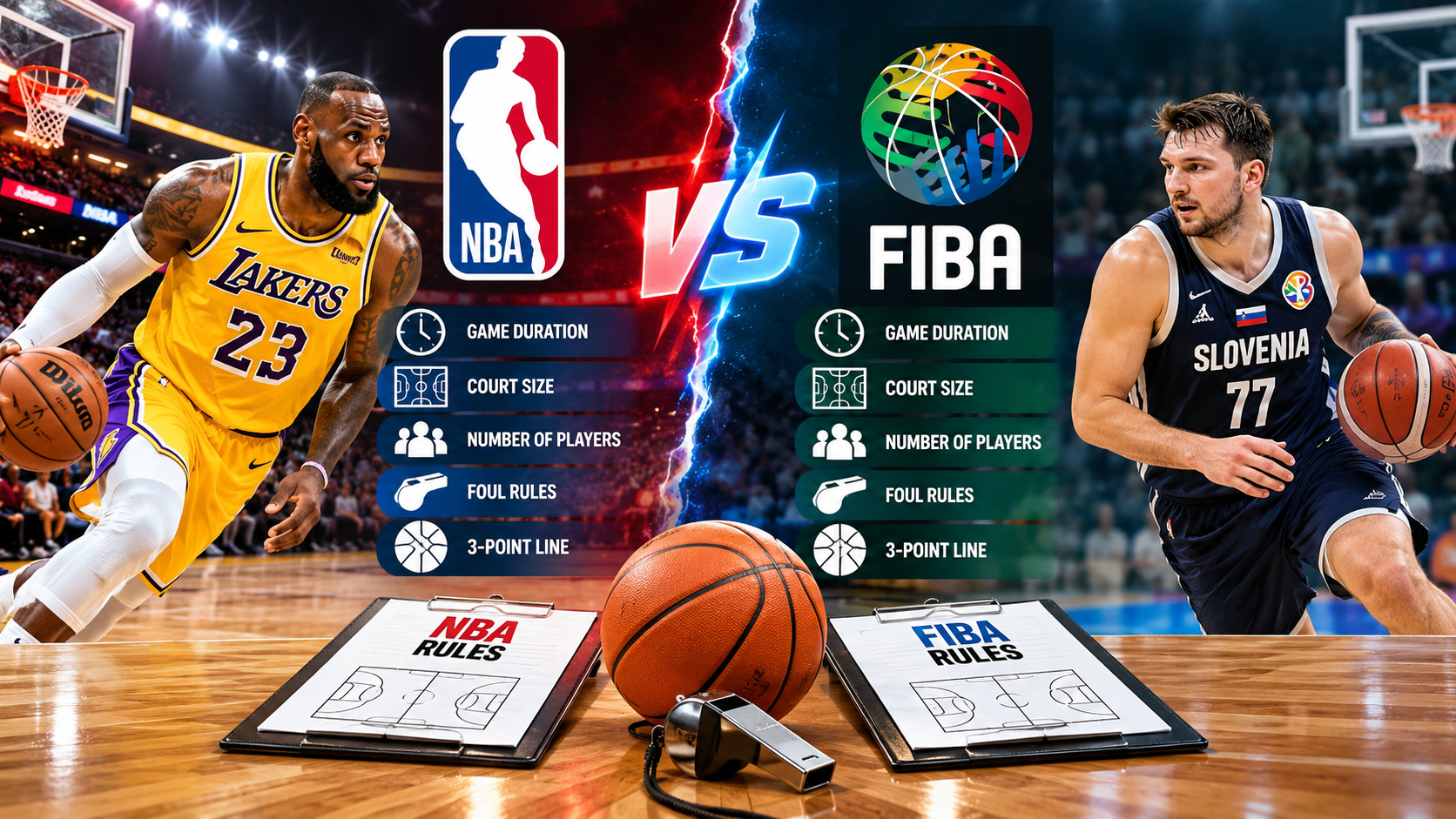
Yet the differences between NBA and FIBA basketball influence much more than the final score. They affect how teams defend the paint, manage fouls, organize offensive possessions, and approach the final minutes of a close game.
For fans who regularly watch the NBA and international competitions such as the Olympic Games or FIBA Basketball World Cup, these differences can sometimes be confusing.
Why can a defender remain near the basket in international basketball without being penalized for defensive three seconds? Why does an NBA game last longer? And why do certain NBA stars need time to adjust when representing their national teams?
Understanding the rules provides useful answers. It also reveals how relatively small differences in regulations can produce distinct approaches to the same sport.
What Are the NBA and FIBA?
The NBA is a professional basketball league based in North America, featuring franchises from the United States and Canada. It is widely regarded as the world’s leading professional men’s basketball league, attracting many of the sport’s most talented players.
FIBA, or the International Basketball Federation, is basketball’s international governing body. It establishes official rules used in major international competitions and by many national leagues and basketball organizations.
FIBA oversees competitions such as the FIBA Basketball World Cup and international basketball tournaments, while Olympic basketball is also played under FIBA rules.
Although the NBA and FIBA share basketball’s fundamental principles, they maintain separate rulebooks.
Neither system should automatically be considered more legitimate than the other. Each has developed regulations suited to its competition structure and basketball traditions.
NBA vs. FIBA Basketball Rules: Quick Comparison
The following table summarizes several important differences between standard NBA games and FIBA five-on-five basketball.
| Rule | NBA | FIBA |
|---|---|---|
| Game duration | 48 minutes | 40 minutes |
| Quarter length | 12 minutes | 10 minutes |
| Court dimensions | 94 × 50 feet | 28 × 15 meters |
| Three-point arc | 23 ft 9 in above the break; 22 ft in corners | 6.75 m, approximately 22 ft 1.75 in, with shorter corner distances |
| Shot clock | 24 seconds | 24 seconds |
| Offensive rebound reset | 14 seconds | 14 seconds |
| Personal foul limit | 6 | 5 |
| Defensive three seconds | Enforced | No equivalent restriction |
| Overtime | 5 minutes | 5 minutes |
| Timeout requests | Eligible players or head coach, subject to rule conditions | Coach or first assistant coach through the scorer’s table |
Some rules are similar, including the 24-second shot clock and five-minute overtime periods. Others create meaningful differences in how games unfold.
1. Game Duration: NBA Games Are Eight Minutes Longer
One of the easiest differences to recognize is the length of the game.
An NBA game consists of four 12-minute quarters, producing 48 minutes of regulation playing time.
Under FIBA rules, each quarter lasts 10 minutes, resulting in a 40-minute regulation game.
That eight-minute difference can influence scoring totals, player rotations, and the importance of individual possessions.
How Game Length Affects Scoring
NBA teams have more regulation time to generate scoring opportunities. Combined with differences in offensive talent, pace, and tactical approach, this contributes to the different scoring environments seen across competitions.
However, it would be misleading to attribute every scoring difference to game length alone.
Shot selection, defensive quality, team strategy, and the number of possessions also matter.
A 40-minute international game can still feature a fast pace, while a 48-minute NBA game can be played deliberately.
How Game Length Affects Rotations
Coaches must distribute playing time differently.
In the NBA, stars may play extended minutes while teams manage a longer schedule and more possessions.
In international competition, coaches have less total playing time available, so foul trouble or a brief scoring drought can carry greater immediate consequences.
The shorter game does not necessarily make every possession more valuable mathematically, but it leaves less time to recover from a significant deficit.
2. Court Size: A Smaller Playing Area Under FIBA Rules
NBA courts measure 94 feet long and 50 feet wide, approximately 28.65 by 15.24 meters.
FIBA courts measure 28 meters long and 15 meters wide.
The difference may appear modest, but basketball is a game where small amounts of space matter.
A slightly shorter and narrower court can influence defensive positioning, passing angles, and how teams organize their half-court offense.
It is important not to exaggerate this effect. The court-size difference is relatively small compared with the impact of defensive rules, player personnel, and coaching strategies.
3. Three-Point Line: Distance Changes Shot Selection
The three-point line is another recognizable difference.
In the NBA, the arc is 23 feet 9 inches from the center of the basket above the break, with a shorter 22-foot distance in the corners.
FIBA uses a 6.75-meter arc, approximately 22 feet 1.75 inches, with shorter distances near the corners.
This means certain three-point attempts are taken from closer range in international basketball.
Does a Shorter Three-Point Line Make Shooting Easier?
For some players, a shorter distance may improve shooting comfort. However, game conditions matter.
A shooter who is accustomed to NBA spacing may encounter defenders positioned differently under FIBA rules.
International opponents may protect the paint more aggressively or use compact defensive structures that alter where open shots become available.
As a result, the shorter line does not guarantee that a player will shoot a higher percentage.
Why NBA Shooters Still Need to Adjust
Elite NBA shooters often have the range to make shots comfortably from beyond the FIBA arc.
But shooting distance is only one component of offensive efficiency.
Players must also adjust to different screening angles, defensive rotations, teammate movement, and the rhythm of international games.
4. Defensive Three Seconds: One of the Most Important Differences
The NBA has a defensive three-second rule.
In general, a defender cannot remain in the restricted defensive lane for more than three consecutive seconds without actively guarding an opponent, subject to the rule’s specific conditions.
The purpose is partly to prevent defenders from simply occupying the paint indefinitely.
FIBA does not have an equivalent defensive three-second violation.
This difference can significantly influence defensive strategy.
Why FIBA Defenses Can Protect the Paint Differently
Under FIBA rules, a defender may remain near the basket without the NBA’s defensive three-second restriction.
That allows teams to position rim protectors more consistently around the paint.
For offensive players who rely on driving toward the basket, this can create difficult situations.
A defender may already be waiting near the rim before the attacker begins moving downhill.
Teams can respond through outside shooting, passing, screening, and movement that forces defenders away from the basket.
It is worth remembering that the NBA also allows zone defense. The key distinction is the defensive three-second restriction, not a blanket prohibition against zones.
5. Goaltending and Basket Interference
NBA and FIBA rules both prohibit illegal interference with certain shots near the basket.
However, they differ in how players may interact with the ball around the rim.
In the NBA, the basket-interference rules place restrictions on touching a ball while it is on or within the basket cylinder.
Under FIBA rules, once a shot has touched the ring, players generally have more freedom to play the ball, provided other interference restrictions do not apply.
This can create situations where an international player legally tips or clears a ball that would be restricted under NBA rules.
Why This Matters for Rebounding
Players must react quickly to shots that contact the rim.
Big men who are accustomed to NBA basket-interference restrictions may need to adjust their timing in FIBA competition.
Offensive players can also benefit from understanding when a ball becomes playable.
Because the rules include technical conditions, players cannot assume that every ball touching the rim may be grabbed in every circumstance.
6. Personal Fouls: Five in FIBA, Six in the NBA
NBA players are disqualified after committing six personal fouls.
In FIBA basketball, a player must leave the game after five fouls.
This affects coaching decisions, especially when an important player collects several fouls early.
Imagine a team’s leading scorer commits three fouls during the first half of a FIBA game.
With only two fouls remaining before disqualification, the coach may need to reduce that player’s minutes or adjust defensive assignments.
NBA coaches face similar problems, but the additional personal foul and longer game create a different balance.
Neither system eliminates aggressive defense. Instead, both require players to understand the consequences of unnecessary contact.
7. Team Fouls and Free Throws
Both systems use team-foul penalties, but their administration differs.
In standard FIBA regulation quarters, a team enters the team-foul penalty after committing four team fouls in the quarter.
Subsequent qualifying defensive personal fouls generally result in two free throws, even when the fouled player was not shooting.
The NBA also uses a team-foul penalty, but it includes additional rules and exceptions, particularly for the final two minutes of a period.
These distinctions matter when coaches decide whether to defend aggressively, substitute a player, or intentionally foul late in a game.
They also influence how players interpret contact and manage foul trouble.
8. Timeouts and Late-Game Strategy
Timeout rules differ in quantity, availability, and who may request them.
In the NBA, teams have seven timeouts during regulation, with limits on how many may be used late in the fourth quarter. Additional timeouts are available in overtime.
Under FIBA rules, teams receive two timeouts in the first half, three in the second half, and one in each overtime period.
FIBA also limits how many second-half timeouts may be used during the final two minutes of the fourth quarter.
Unlike the NBA, FIBA timeouts are requested through the scorer’s table by the coach or first assistant coach rather than directly by a player on the court.
Advancing the Ball
Both competitions provide certain opportunities to advance the ball to the frontcourt after a late-game timeout, but the eligibility conditions and procedures are different.
These rules can influence the final possession of a close contest.
A coach must understand when a timeout can be requested and where the next throw-in will occur.
Small procedural differences can determine whether a team has enough time to create a quality shot.
9. Shot Clock: More Similar Than Many Fans Realize
Both the NBA and FIBA use a 24-second shot clock.
Both also use a 14-second reset in qualifying situations, including when the offense retains possession after an offensive rebound.
The exact reset depends on how possession continues, the location of the throw-in, and the applicable rule conditions.
Because the basic shot-clock structure is similar, the different playing styles cannot simply be explained by one competition giving teams substantially more time to shoot.
Instead, defensive positioning, coaching philosophy, roster construction, and game management play larger roles.
10. Traveling, Gather Steps, and Officiating
Traveling is often discussed when comparing NBA and international basketball.
Fans sometimes assume that NBA players are allowed to take more steps than FIBA players.
That description is too simplistic.
Both rule systems recognize a legal gather or control phase and allow two steps in common situations when a moving player gathers the ball.
The detailed definitions, enforcement practices, and interpretation of particular movements may differ.
For players moving between competitions, the most important adjustment is understanding how officials interpret footwork and ball control.
Experienced players cannot rely solely on habits developed in one league.
How NBA and FIBA Rules Influence Playing Style
The rules create different tactical possibilities, but they do not force every team to play the same way.
Some NBA teams emphasize physical defense and deliberate half-court possessions. Some international teams play quickly and depend heavily on individual creators.
Nevertheless, certain tendencies can be observed.
NBA Basketball: Spacing and Individual Creation
Modern NBA offenses often prioritize floor spacing, pick-and-roll combinations, three-point shooting, and opportunities for elite players to attack mismatches.
The defensive three-second rule makes it more difficult for a rim protector to remain stationary in the paint without actively guarding an opponent.
This can create opportunities for guards and wings who excel at driving.
The NBA’s larger court and longer three-point arc also contribute to its particular spacing environment.
However, teamwork remains essential. Even the most talented individual scorers depend on screens, passing, and coordinated movement.
FIBA Basketball: Collective Execution and Defensive Flexibility
International teams may use compact defensive structures, disciplined rotations, and carefully organized half-court possessions.
The absence of defensive three seconds gives coaches greater flexibility when positioning rim protectors.
Offenses may need to move the ball quickly and create advantages through coordinated actions rather than relying only on isolated drives.
Still, international basketball includes exceptional individual talent. Players such as Luka Dončić, Nikola Jokić, and Giannis Antetokounmpo demonstrate that creativity and individual skill remain central to the game across different competitions.
Why NBA Stars Sometimes Struggle in International Games
An NBA superstar’s reputation does not guarantee an easy transition to FIBA basketball.
International opponents may use defensive structures that are less common in the NBA.
Players may encounter a rim protector positioned near the basket for longer periods, different three-point spacing, and unfamiliar officiating interpretations.
National teams also have limited preparation time compared with NBA franchises that train and compete together throughout a long season.
Team chemistry, role clarity, and familiarity with teammates can therefore become especially important.
When an NBA player struggles internationally, the explanation is rarely as simple as one league being more difficult than the other.
The challenges are different.
How International Basketball Has Influenced the NBA
The relationship between the NBA and international basketball works in both directions.
International players have helped transform NBA offenses through passing, shooting, versatility, and innovative approaches to the game.
Dirk Nowitzki demonstrated the effectiveness of a seven-foot scorer who could operate away from the basket.
Manu Ginóbili brought creativity and unconventional attacking angles to San Antonio.
Nikola Jokić has shown how an elite passing center can organize an entire offense.
Luka Dončić has combined advanced pick-and-roll playmaking with exceptional control of tempo.
These examples show that basketball innovation does not belong exclusively to one competition.
The NBA and international basketball continually influence one another as players and coaches exchange ideas.
Is NBA Basketball More Difficult Than FIBA Basketball?
This question often creates debate among basketball fans.
The NBA features an extraordinary concentration of professional talent, elite athleticism, and sophisticated offensive systems.
FIBA competitions can present different challenges through compact defenses, shorter games, and the importance of national-team chemistry.
However, comparing the NBA with FIBA is not entirely straightforward.
The NBA is a specific professional league. FIBA is an international governing body whose rules are used across competitions with widely varying levels of talent.
A more meaningful comparison is between NBA competition and elite international tournaments such as the Olympic Games or FIBA Basketball World Cup.
Even then, the difficulty depends on the opponent, roster, preparation, and circumstances.
Neither format can be reduced to a single claim about which is universally harder.
Which Rules Are Better for Basketball?
There is no objective answer that every fan or coach will accept.
Supporters of NBA rules may prefer the additional space available for drives, the longer games, and the emphasis on individual offensive creativity.
Supporters of FIBA rules may appreciate the freedom to organize compact defenses, the shorter game format, and the tactical adjustments required around the basket.
Both systems reward basketball fundamentals.
Players still need to shoot accurately, defend responsibly, rebound, communicate, and make good decisions.
What changes is the environment in which those skills are applied.
Frequently Asked Questions About NBA and FIBA Rules
What is the main difference between NBA and FIBA basketball?
The main differences include game length, court dimensions, three-point distance, personal foul limits, defensive three-second rules, and certain basket-interference procedures.
How long is an NBA game compared with a FIBA game?
An NBA regulation game lasts 48 minutes, divided into four 12-minute quarters. A FIBA regulation game lasts 40 minutes, divided into four 10-minute quarters.
Is the three-point line closer in FIBA basketball?
Yes. FIBA’s standard arc is 6.75 meters from the basket, while the NBA arc is farther away above the break. Both competitions use shorter distances near the corners.
Does FIBA have a defensive three-second rule?
No. FIBA does not use the NBA’s defensive three-second restriction, allowing different approaches to protecting the paint.
How many fouls are allowed in NBA and FIBA basketball?
An NBA player is disqualified after six personal fouls. A FIBA player is disqualified after five fouls.
Do the NBA and FIBA use the same shot clock?
Yes. Both use a 24-second shot clock and a 14-second reset in qualifying situations.
Are NBA and FIBA courts the same size?
No. NBA courts measure 94 by 50 feet, while FIBA courts measure 28 by 15 meters.
Can players touch the ball after it hits the rim in FIBA basketball?
FIBA generally permits more interaction with a shot after it touches the ring than NBA basket-interference rules allow, although specific restrictions still apply.
Are Olympic basketball games played under NBA rules?
No. Olympic basketball uses FIBA rules rather than the NBA’s domestic rulebook.
Why do NBA players need to adjust to FIBA basketball?
They may encounter different defensive positioning, court spacing, officiating interpretations, foul limits, and tactical responsibilities.
Conclusion: Two Rulebooks, One Global Sport
NBA and FIBA basketball share the same fundamental game, but their rule differences create distinct tactical environments.
The NBA’s longer games, defensive three-second restriction, and court dimensions help shape its particular style of offense and defense.
FIBA’s shorter games, five-foul limit, and different basket-interference rules create other challenges for players and coaches.
Neither system eliminates the importance of teamwork or individual excellence.
Instead, each rewards players who understand the rules and can adjust their decisions accordingly.
As basketball continues to grow internationally, these differences remain an important part of the sport’s identity.
For fans, learning both systems makes NBA games, Olympic tournaments, and international championships more interesting to watch.
For players, understanding both rulebooks is another step toward becoming more complete basketball competitors.
Leave a Reply